Thursday, September 06, 2018

Richmond Military Settlement Plaque

In Richmond Ontario, the Richmond Military Settlement Plaque stands just east of the two Richmond Fair plaques on the north side of Perth Street, west of Colonel Murray Street.


RICHMOND MILITARY SETTLEMENT 1818

In August, 1818, some thirty disbanded veterans of the 99th Regiment let by Captain G.T. Burke, arrived in newly surveyed Goulbourn Township. These formed the advance party of a military settlement planned and supported by the quartermaster-general's department. Here they laid out a town site named after the governor general, the Duke of Richmond. Storehouses were built, settler's cabins erected and the colonists provided with farm implements and rations. Under the general supervision of Lieutenant-Colonel Francis Cockburn, about 400 heads of families, including some civilians, were established in the settlement by the end of 1818, thus forming the first large community within the present Carleton County.

Erected by the Ontario Archaeological and Historic Sites Board.


Monday, September 03, 2018

Richmond Fair Plaques

In Richmond, Ontario, on the north side of Perth Street west of Colonel Murray Street stand a pair of plaques dedicated to the Richmond Agricultural Society and the Richmond Fair.


COUNTY OF CARLETON
AGRICULTURAL SOCIETY
1844 — 1944


PRESENTED BY
ONTARIO DEPARTMENT of AGRICULTURE
IN RECOGNITION OF
ONE HUNDRED YEARS SERVICE

SEPTEMBER 8TH 1944


RICHMOND
AGRICULTURAL SOCIETY
1844 - 199
PRESENTED BY
ONTARIO MINISTRY OF AGRICULTURE, FOOD
AND RURAL AFFAIRS
IN RECOGNITION OF
ONE HUNDRED AND FIFTY YEARS OF SERVICE


Thursday, August 30, 2018

Charles Lennox Plaque

In Richmond, Ontario on the east side of Old Richmond Road, south of Steeple Hill Crescent, stands a cairn on which there is a plaque commemorating Charles Lennox.


Charles Lennox, 4th Duke of Richmond and Lennox


CHARLES LENNOX
4th DUKE OF RICHMOND AND LENNOX
(1674-1819)


Charles Lennox was appointed Commander-in-Chief of all the British North American colonies and Governor-in-Chief of Lower Canada in May 1818. He received a mandate to improve the colonies' defences and inland navigation system. Lennox recommended the strengthening of the fortification at Québec City and the building of a fort, later named in his honour, on the Île aux Noix and also promoted canal construction on the Ottawa River. His sudden death near here only a year after his appointment was lamented in both Canada and Britain.

Historic Sites and Monuments Board of Canada
Government of Canada


CHARLES LENNOX
4e DUC DE RICHMOND ET DE LENNOX
(1674-1819)


Charles Lennox fut nommé commandant en chef des colonies de l'Amerique du Nord britannique et gouverneur en chef du Bas-Canada en mai 1818. On lui confia le mandat d'améliorer les défenses des colonies et la navigation intérieur. Lennox recommenda le renforcement des fortifications de Québec et la construction d'un fort, nommé plus tard en son honneur, à l'île aux Noix. Il encouragea en outre la création d'écluses sur la rivière des Outaouais. L'annonce de sa mort subite survenue près d'ici, un an seulement après sa nomination, jeta l'émoi tant chez les Canadiens que chez les Britanniques.

Commission des lieux et monuments historiques du Canada
Gouvernement du Canada


Monday, August 27, 2018

St. John's Anglican Church

In Richmond, Ontario, St. John The Baptist Anglican Church stands on the southwest corner of Fowler Street and Royal York Street West, near the site of the original St. John's Anglican Church.


ST. JOHN'S ANGLICAN CHURCH 1823

On this site stood the first church to be commenced in what is now Carleton County. Among the pioneers who formed the Richmond Military Settlement in 1818 were many Anglicans, and in 1822 the Rev. John Byrne was appointed to minister to the members of that communion in Richmond and March. The original St. John's Church, a frame and stone structure, was begun in 1823, and the following year Byrne established residence in Richmond, where he served until his death in 1828. He was succeeded in 1828 by the Rev. Robert Short through whose efforts the church was completed by 1830. The present St. John's was built to replace the first church in 1859-60.

Erected by the Ontario Archaeological and Historic Sites Board.


Thursday, August 23, 2018

Kwakiutl Totem

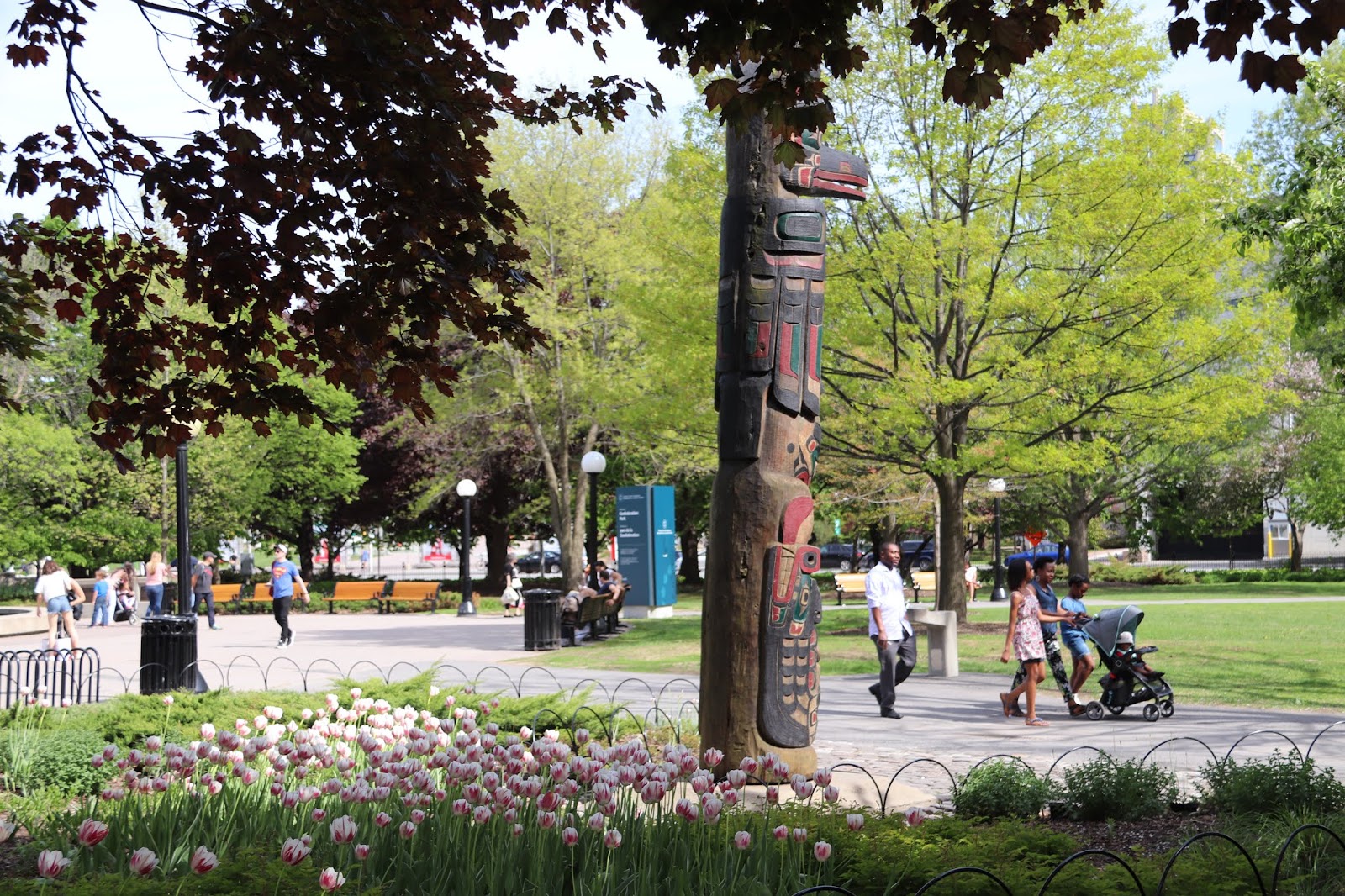
The Kwakiutl Totem stands in Confederation Park near the southeast corner of Elgin Street and Slater Street.


1871 - 1971
KWAKIUTL TOTEM


Donated by the native Indian people of British Columbia to commemorate the centenary of union of the province of British Columbia with Canada, July 20, 1871. Carved at Victoria B.C. by Mr. Henry Hunt of the Kwawkewith Indian Band.

A project of the First Citizens' Fund and the British Columbia Centennial '71 Committee


1871 - 1971
KWAKIUTL TOTEM


Don de la population Autochtone de la Colombie-Britannique pour commémorer le centenaire de l'union de cette province au Canada le 20 juillet 1871. Sculpté à Victoria (C.-B.) par M. Henry Hunt de la Bande Indienne de Kwawkewith.

Sous l'égide du First Citizenss' Fund et du British Columbia Centennial '71 Committee