Monday, July 21, 2014

Embrun Cenotaph

The Embrun Cenotaph is on the grounds of the Township of Russell administrative centre on the corner of Notre Dame Street and Industrial Street in Embrun.


Saturday, July 19, 2014

Russell Cenotaph

You can find the Russell Cenotaph on the corner of Legion Lane and First Avenue in Russell. It stands as Part of the Russell branch, 372, of the Royal Canadian Legion.


Wednesday, July 16, 2014

Gloucester Cairn

The Gloucester Cairn is located near the entrance to the Greely branch (627) of the Royal Canadian Legion on the north side of Mitch Owens Road between Ramsayville Road and 8th Line Road. "Gloucester Cairn" is my name for the memorial. It may have a different official title. As far as I can determine from researching it, this particular memorial does not commemorate Royal Canadian Navy personnel who have died in combat, but rather the historical significance of the Royal Canadian Navy base situated at the site and the men and women who served there.


 I found the following article that tells some of the story of the base, which is almost gone, and the memorial that now stands there.

The article is from the Historic Gloucester Quarterly Newsletter of the Gloucester Historical Society
and The Gloucester Museum and Archives
, Volume 6 No. 2 Fall 2005

HMCS Gloucester
By Mary Boyd

Over the past year or so, a group of retired Chiefs and Petty Officers (Pos) of the old Communicator (S) Branch have been doing the preparatory legwork for a project to preserve the memory of HMCS Gloucester. The intention was to install a cairn with a commemorative plaque at the former entrance road to the base.

The property on which the former Naval Radio Station was located has deteriorated badly since the Gloucester base was closed in 1972. The large PMQ area is now a vacant field. The parade square and the central mast are gone. Facing the old parade square on the west side was a long building, which housed the Officers' wardroom at one end and the Chiefs' and Petty Officers' mess at the other. There is no real evidence that this building was ever there. Facing this area on the opposite side of the parade ground was the training building with, at its centre, a quarterdeck, ship's bell, and all the paraphernalia of a naval shore establishment. This building, too, is gone. To the north of the parade grund was the main galley and cafeteria - also gone. To the right rear was the large L-shaped barracks block for Leading Seamen and below. This too has disappeared. The only remnant of the old navy base (as it was called) is the gymnasium, which is now the local branch of the Royal Canadian Legion.

HMCS Gloucester, like the other stations in the Supplementary Radio System (SRO), was always a mystery to the other parts of the Royal Canadian Navy (RCN). The activities that took place inside the Operations sections was a source of specultion by those not cleared to go "beyond the Green Door." Indeed, for most of its existence, the Supplementary Radio System was the only branch of the RCN to perform the same tasks in peacetime as it would in war, that is the collection and processing of intelligence obtained surreptitiously by electronic means. This includes high frequency direction finding, interception of radio transmissions, and cryptographic analysis. Glouceser - nicknamed Glo by most branch members - was unique in this framework in that it was the headquarters for the SRS and the central training establishment for all the operational skills required in the branch. Glo achieved this assignment in teh classic navy way, silently and without fanfare. It produced many hundreds of skilled operators, technicians, and analysts during its three decades of existence from 1943 to 1972.

The program to ensure that Glo's memory is perpetuated has been spearheaded by retired CPO Morley McAllister, assisted by Chiefs Gerry Burton, Don Cameron, Terry Whalley, Ray White and others. The project was completed by early summer 2005.

A six-foot cairn was erected on the boulevard portion of the main road entering the old station. On this cairn a bronze plaque tells the story of the pride the former members have for being part of this great group of shipmates. The plaque—dans les deux langues oficielles, naturallement—will reflect Glo's role in World War II, the Cold War, and its legacy for those who follow.


NRS 1943 - 1950
HMCS 1950 - 1966
CFS 1966 - 1972

Gloucester
Knowledge through Discipline

Opened in 1943 as a Naval Radio Station
utilizing High Frequency Direction Finding
(HFDF) to aid in the combat against German U-
boats in WWII, Gloucester evolved into a Military
Signals Intelligence (SIGINT) communication
and training establishment.

This monument is dedicated to the men and
women who trained and served at this site. Their
many contributions to the security of this nation
must never be forgotten.

In War or Peace, it matters not, the mission does not change.

Erected by the Supplementary Radio Systems Old Timers Association 2005


Sunday, July 13, 2014

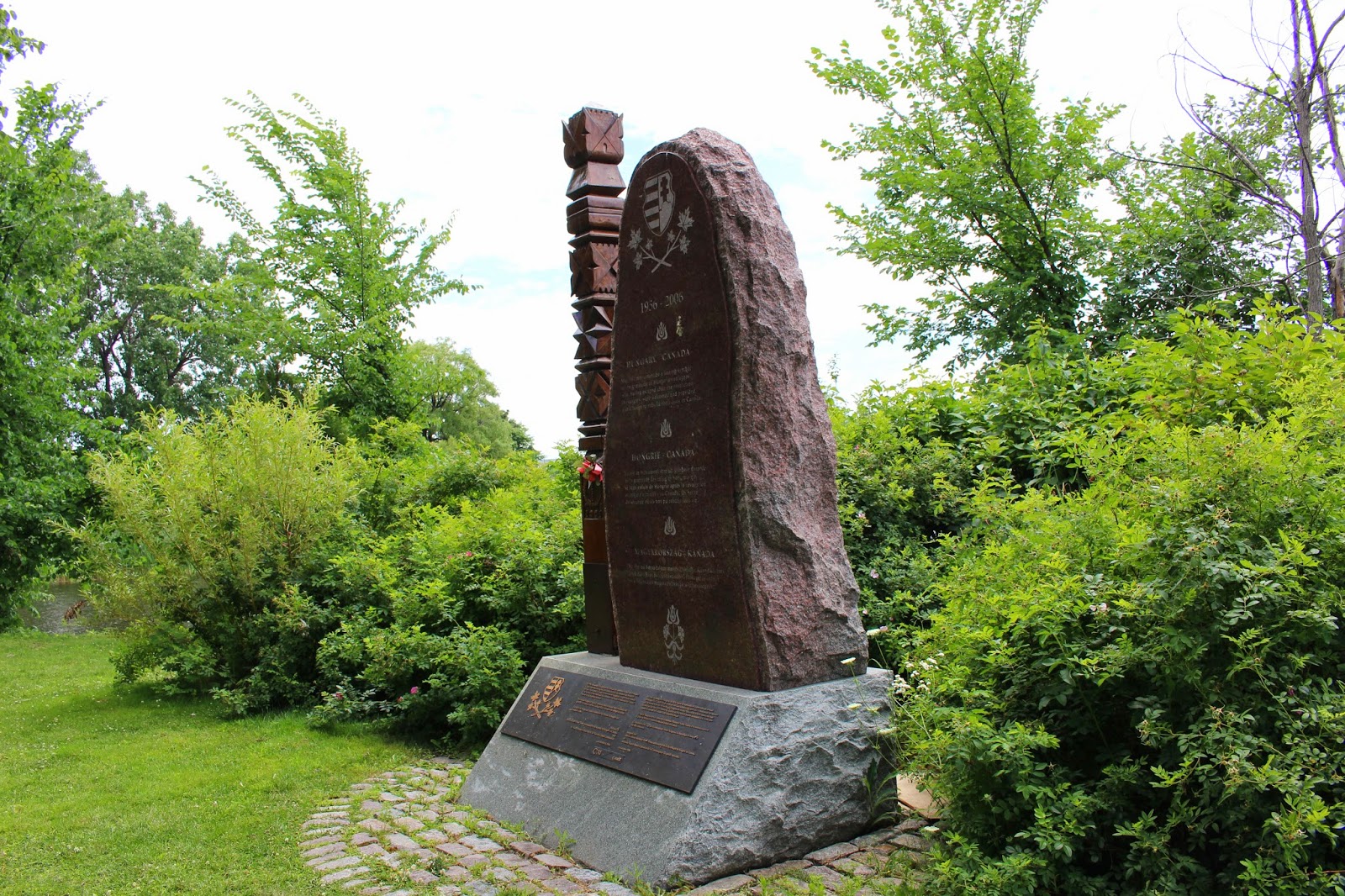
Hungary - Canada Monument

The Hungary - Canada Monument stands at the south end of Maple Island in the Rideau River. Union Street, now restricted to foot and bicycle traffic accesses Maple Island.


HUNGARY - CANADA

May this monument be a lasting symbol
of the gratitude of Hungarian refugees
who, having escaped after the revolution
in Hungary, were welcomed and provided
a safe haven to rebuild their lives in Canada.


In 1956, thousands of Hungarians fled reprisals and oppression in their native Hungary.
Canada responded with significant humanitarian aid and measures that permitted
the rapid resettlement in Canada of almost 40,000 Hungarian refugees within months
of the revolution. Fifty years later, this monument was raised to commemorate Canada's
response to this desperate situation.

The wooden Hungarian "kopjafa" represents nobility, honour, peace, friendship and
gratitude. The granite from the Canadian Shield represents the strength of Canada.

Erected by the Hungarian Canadian community, the Republic of Hungary and
Canadian friends.

Dedicated by His Excellency Dénes Tomaj, Ambassador of the Republic of Hungary to Canada
and Mr. Marcel Beaudry, Chairman of the National Capital Commission on October 4, 2006.


Saturday, July 12, 2014

Canloan Memorial

On going to photograph this memorial the first thing that struck me is that the Canloan Memorial is hard to find. In a photograph taken shortly after it was dedicated shows it out in the open with nothing around it. Since then it has been surrounded with bushes and trees such that it cannot be seen from the road unless people are looking to see it and even then it takes some neck bending to do that. The Canloan Memorial can be found at Sussex Drive and Stanley Avenue on the riverside of Stanley Avenue.


Erected by the governments of Canada and the United Kingdom,
the British Regiments, the Canloan Army Officers Association
and Canloan next of kin. Designated "Canloan" 673 Canadian
officers volunteered for loan to the British Army and took
part in the invasion and liberation of Europe 1944 -45.
Canloan total casualties were 465 of which 128 were fatal.
Their fallen are honoured in this quiet place in gratitude
and remembrance of the cost of liberty.

Unveiled by
His Excellency
Major-General the Right Honorable
Georges - P. Vanier
DSO, MC, CD
Governor-General
of
Canada
3 June 1961


Thursday, June 26, 2014

The Canadian Tribute to Human Rights

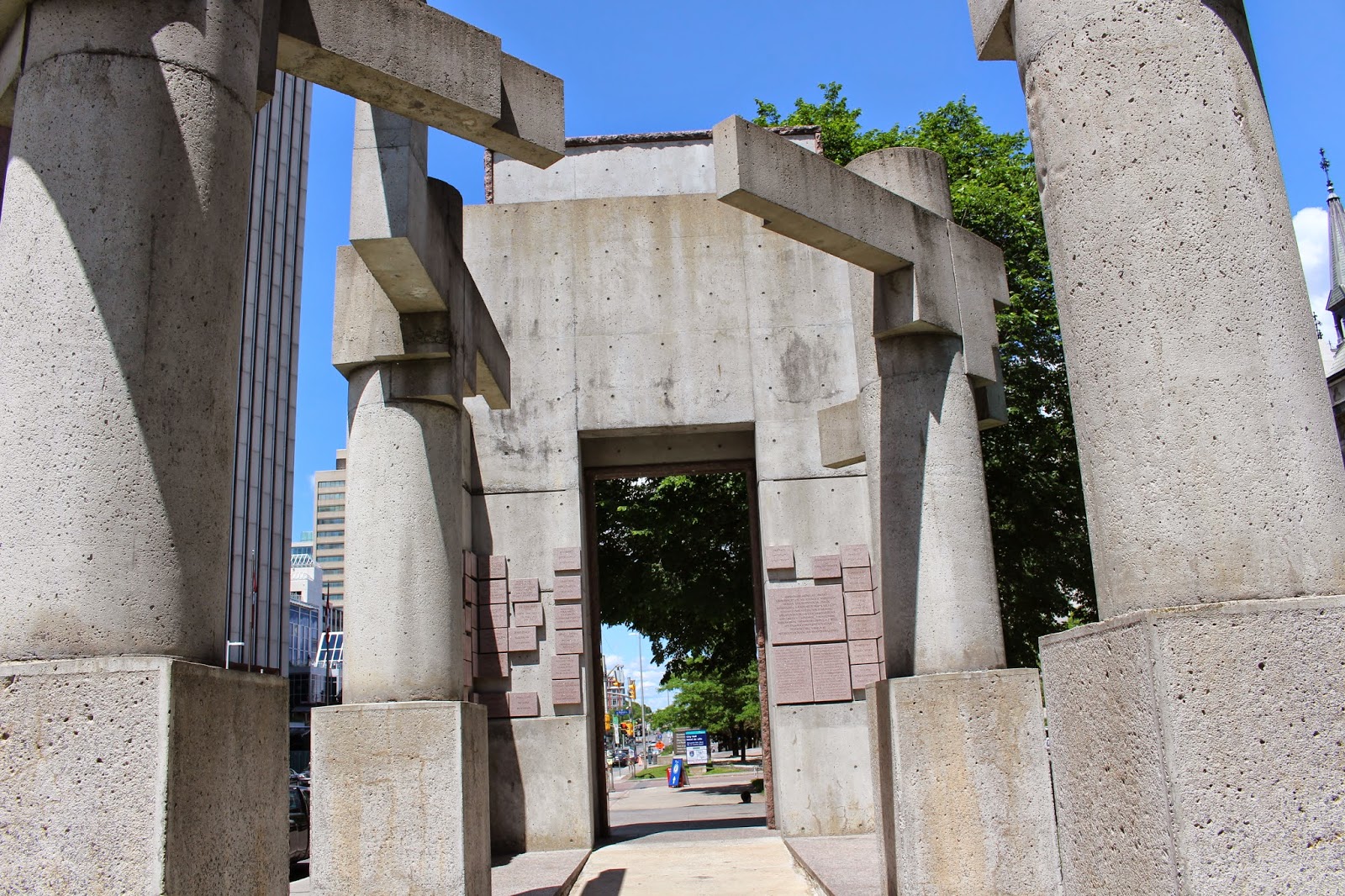
You will find the Canadian Tribute to Human Rights situated on the Ottawa City Hall grounds on the northeast corner of Elgin and Lisgar. This large memorial structure provides a place for people to sit down and rest, chat, have lunch, read or what have you. I think that's appropriate.


Major Donors since 1993

Eiko Emori
Carroll Holland
James and Annette McCoubrey
CRB Foundation
GE Canada
National Assoiciation of Friendship Centres
Vincent Spirito and Sons
Welch LLP


Designed, engraved
and installed by
Martel and Sons, Inc.


THE CANADIAN TRIBUTE TO HUMAN RIGHTS

Held high on the Monument in English and French are the words "Equality, Dignity, Rights" from the United Nations Universal Declaration of Human Rights. These three concepts are inscribed on 73 granite plaques in Aboriginal languages spoken in Canada, using syllabics or Roman orthography. Grouped in language families, the plaques are located on the interior walls, known as the "House of Canada." An Algonquin statement accompanying the language plaques acknowledges that this symbolic monument stands on the traditional territory of the Algonquin Anishnabe People.


The Canadian Tribute to Human Rights

The Canadian Tribute to Human Rights
celebrates the desire of people to live in
freedom and dignity and to share equal rights.


Enter the Tribute. A path traces a symbolic
procession through a portal transcribed with the
first words of the United Nations Universal
Declaration of Human Rights.


The Tribute was conceived by a community of
volunteers from across Canada engaged in the
struggle for the rights of all people.
It was created by the artist, Melvin Charney.


Sparked in 1983 by the struggle of the Polish
trade union Solidarność and dedicated on
September 30, 1990, in the presence of the
Dalai Lama of Tibet, The Canadian Tribute to
Human Rights is a reminder that until all
rights are respected, none are secure.


The land upon which this
structure stands is part of the
traditional territories of the
Algonquin Anishnabe People.
We have occupied these lands
since time immemorial. It is
fitting that this symbol should
stand here as a reminder of
the suffering of oppressed
people everywhere and of our
faith in the wisdom of the
Great Spirit and the promise of
life, dignity, freedom and
equality for all living beings.
We welcome all who come here
to share in our hope.


While I was photographing the memorial this pigeon landed right near me
and its body language pretty much said, "Take my picture." So I did.