Monday, May 19, 2025

Canadian Pride, Harmony in Cultures Mural

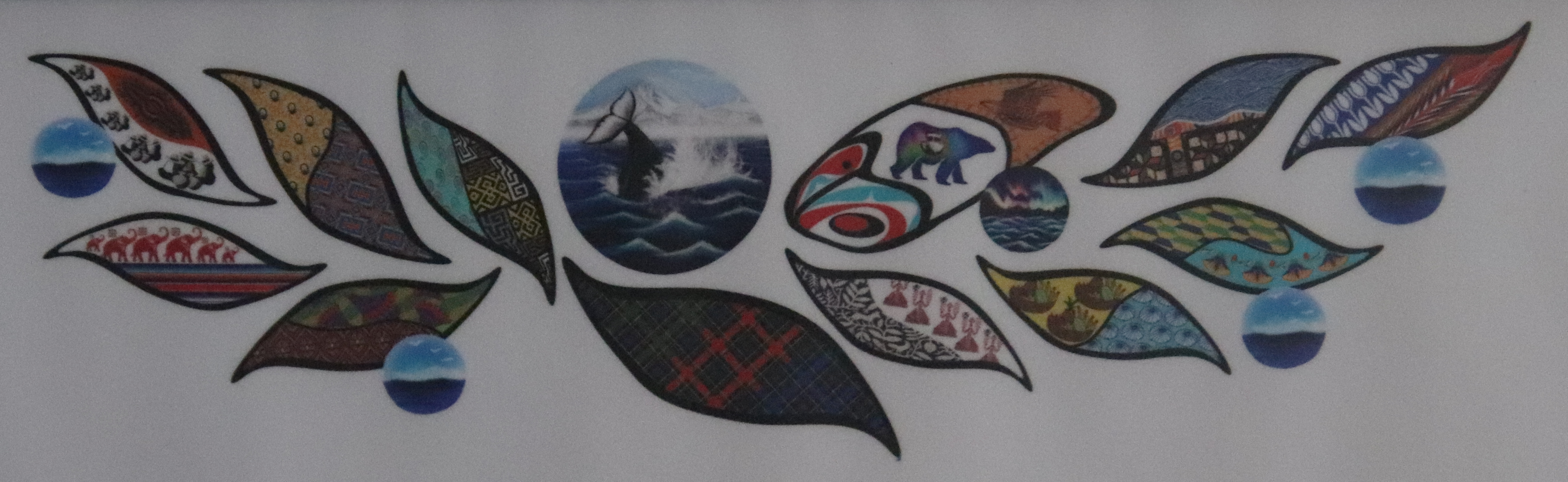
The mural depicting, 'Canadian Pride, Harmony in Cultures,' occupies the east wall of the Hunt Club Riverside Park Community Centre on the northwest corner of McCarthy Road and Paul Anka Drive.


Canadian Pride, Harmony in Cultures

Canadian Pride, Harmony in Cultures mural was donated to the community of Hunt Club-Riverside Park and was one of AOE Arts Council's twelve Neighbourhood Arts 150 projects, an official Canada 150 and Ontario 150 initiative held across the Ottawa region in 2017. This mural represents the flow of cultures in our neighbourhood and in Canada combined with our common values of peace and freedom. The water "Coast to, Coast to Coast" represents Mother Nature and our gratitude for the peaceful environment Canada offers us every day. Aboriginal Canadian cultures and their love and respect for nature are represented in this art piece and the mosaic of fabrics depicts the many countries or areas of the world where immigrants in Hunt Club-Riverside Park came originally or their ancestry. The mural was created by Ottawa artist Claudia Salguero, in collaboration with the diverse and kind volunteer community members of Hunt Club-Riverside Park and the generous participation of Aboriginal artists from the Algonquin, Haida, Irish-Mik'maq and Metis communities.

Funded by: Government of Canada, Ontario 150

Partners: City of Ottawa, Ottawa 2017, Ottawa Community Foundation, Metroland Media, Trinity Development Foundation, Danbe Foundation, The Jewel radio and over 50 community partners


Mural Community Partners:
City of Ottawa Recreation, Cultural and Facilities Services Department, City of Ottawa Councillor Riley Brockington (River Ward), Hunt Club Community Association, Riverside Park Community and Recreation Association, Hunt Club-Riverside Park Community Centre, ND Graphics


Installation: December 2017
La fierté canadienne, l'harmonie entre les cultures

La murale « La fiert Canadienne, l'harmonie entre les cultures » a été donnée à la collectvitité de Hunt Club-Riverside Park et est l'un des douze projets du Conseil des Arts AOE, dans le cadre de son initiative reconnue officiellement dans la programmation Canada 150 et Ontario 150 « L'Art des quartiers 150 », ayant eu lieu dans la region d'Ottawa en 2017. Cette murale représente la diversité Culturelle non seulement dans les quartiers, mais aussi à l'échelle Canadienne, combine aux valeurs communes de paix et de liberté. Le corps d'eau Coast to, Coast to Coast, représente Mère Nature et notre gratitude pour l'environnement harmonieux qu'offre le Canada au jour le jour. Les cultures autochtones, leur amour et leur respect pour la nature sont représentés dans cette œuvre d'art. La mosaïque tissée dépeint plusieurs pays et regions du monde dont sont originaires les immigrants, et leurs ancêtres, des quartiers de Hunt Club-Riverside Park. La murale est l'œuvre de l'artiste ottavienne Claudia Salguero, en collaboration avec des bénévoles de la communauté diversifiée et aimablequ'est Hunt Club-Riverside Park, ainsi qu'avec la génénereuse collaboration d'artistes autochtones et Inuits des nations Algonquine, Inuit, Haïda, Micmac et Métis.

Financée par : le gouvernement du Canada et Ontario 150

Partenaires : Ville d'Ottawa, Ottawa 2017, la Fondation Communautaire d'Ottawa, Metroland Media, Trinity Development Foundation, Danbe Foundation, la station de radio The Jewel et plus de 50 partenaires communautaires

Partenaires communautaires pour la murale :
Ville d'Ottawa, Direction générale des loisirs, de la culture et des installations, Ville d'Ottawa Conseiller Riley Brockington (Quartier Rivière), Association Communautaire de Hunt Club, Association Communautaire de Riverside Partk, Centre Communautaire Hunt Club-Riverside Park, ND Graphics


Installation : Décembre 2017


Monday, May 12, 2025

Mama & Papa Aki Bench

The bench commemorating Mama & Papa Aki stands in Britannia Park south of Greenview Avenue south east of the main parking lot.


In loving memory of Mama and Papa Aki
Always on our minds and forever in our hearts
From family and friends
À la douce mémoire de Mama et Papa Aki
À jamais dans cœurs et nos pensées
De la part de votre famille et de vos amis


Monday, May 05, 2025

A Landscape that Echoes the Past Plaque

The plaque titled, "A Landscape that Echoes the Past," stands on the west of the Trans Canada Trail path facing the Ottawa River, and west of the northwest corner of Vimy Place south of the Canadian War Museum.


A Landscape that Echoes the Past


"Nature may be ravaged by human acts of war, but inevitably it survives, hybridizes, regenerates and prevails. From the healing process emerges hope."
— Raymond Moriyama, lead architect of the Canadian War Museum


AN ARCHITECTURAL CONCEPT BASED ON REGENERATION
The Canadian War Museum before you tells the story of Canada's military past, largely through the experiences of those who lived it.


The museum's architectural concept reflects not only the impact of human conflict on the landscape, but also nature's ability to recover and regenerate from the devastation of war.

See how the building merges into the surrounding landscape. Its gently sloping roof, covered with grass and copper sheathing, creates a sort of bridge between the building and the Ottawa River which flows past Le Breton Flats.

Un paysage qui fait écho au passé

« La nature peut être ravagée par la guerre livrée par l'homme, mais elle survit inévitablement, s'hybride, se régénère et l'emporte. Du processus de guérison naît l'espoir. »
Raymond Moriyama, architecthe principal du Musée canadien de la guerre


UN CONCEPT ARCHITECTURAL QUI FAIT APPEL RENOUVEAU
Les expostitions du Musée canadien de la guerre révèlent le passé militaire du Canada, principalement par les expériences de ceux et celles qui l'ont vécu.


Le concept architectural du musée évoque non seulement l'inciddence des conflits humains sur le paysage, mais aussi la capacité de la nature à reprendre ses droits et à se régénérer de la dévastation engendrée par les guerres.

Observez comment l'édifice se fond dans la paysage. Son toit, recouvert en partie de végétation et en partie d'un revêtement de cuivre, descend en pente douce, créant un pont entre le bâtiment et la rivière des Outaouais qui coule le long des plaines LeBreton.


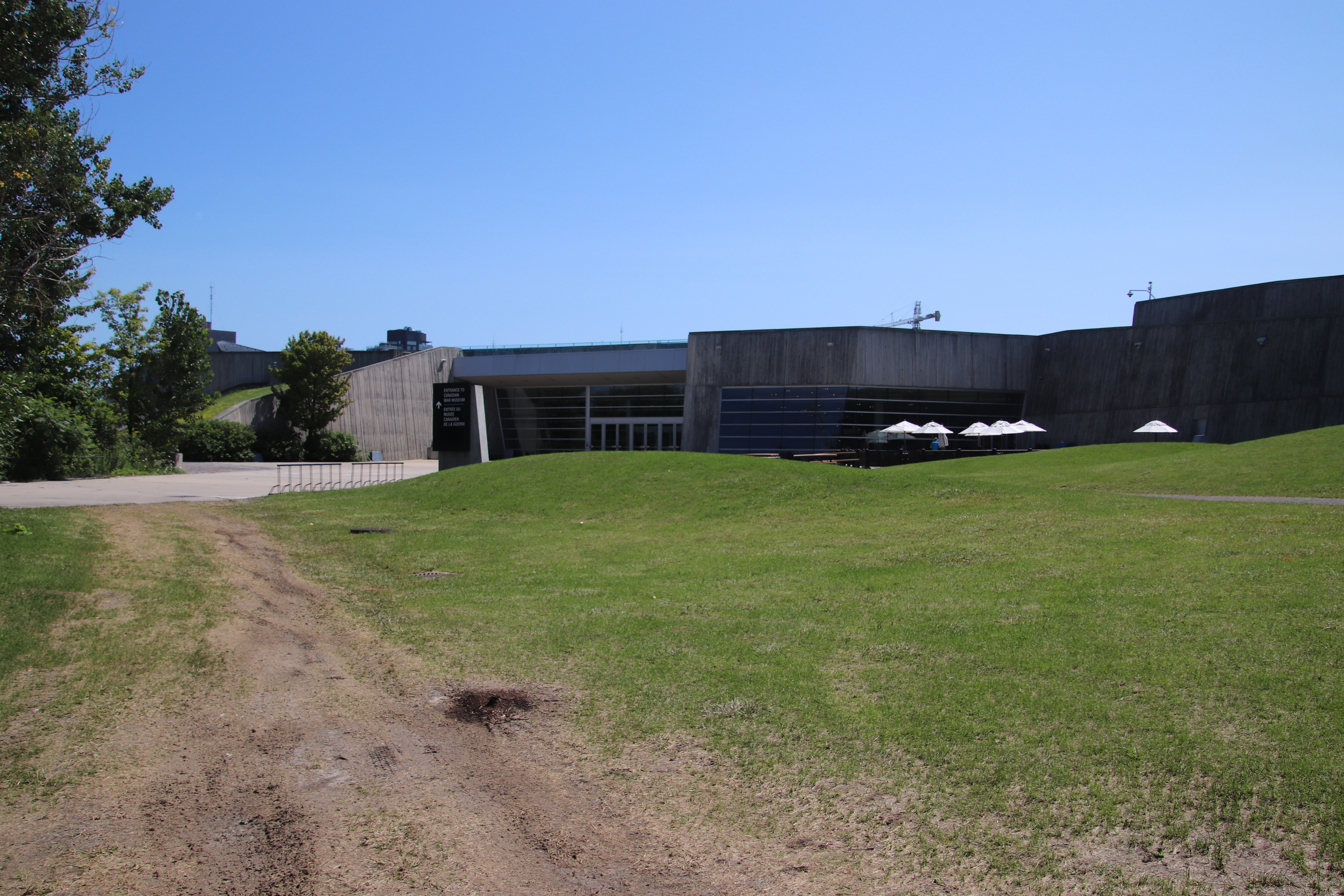
From the location of this plaque a person reading it cannot see The Canadian War Museum. A short walk will bring it into view. The following pictures give some views of the museum.


Monday, April 28, 2025

Fréchette House

The heritage property, Fréchette House, occupies the southwest corner of Union Street and MacKay Street in New Edinburgh.


C. 1877
FRÉCHETTE HOUSE

Fréchette House, with its prominent verge boards, dormers and polychromatic brickwork is a fine example of the picturesque Gothic style. Early occupants, Achille Fréchette, chief translator to the House of Commons, and Annie Howells Fréchette, a noted writer, held literary evenings here in the 1890's for Ottawa's intellectual elite.

Designated Heritage Property 1980
City of Ottawa

C. 1877
LA MAISON FRÉCHETTE

La Maison Fréchette, pa ses rives en pignon imposantes, ses lucarnes et son briquetage polychrome, est un excellent exemple du style néo-gothique pittoresque. Achille Fréchette, traducteur principal à la Chambres des Communes, et Annie Howells Fréchette, auteure de renom, furent parmi les premiers occupants de la maison. Ils y offrirent des soirées littéraires pendant les années 1890 pour l'élite intellectuelle d'Ottawa.

Bien désigné historique, 1980
Ville d'Ottawa


Monday, April 21, 2025

K'Leigh Cundall Tree

The K'Leigh Cundall Tree stands north of the path along the north shore of the Rideau River in the New Edinburgh Park.


IN MEMORY OF
K'LEIGH CUNDALL

WHO DIED TRAGICALLY IN NEW EDINBURGH
ON 8 DECEMBER, 2005, AGED 21
MOURNED BY THE PEOPLE OF HER COMMUNITY


Monday, April 14, 2025

Workers on the Rideau Plaque

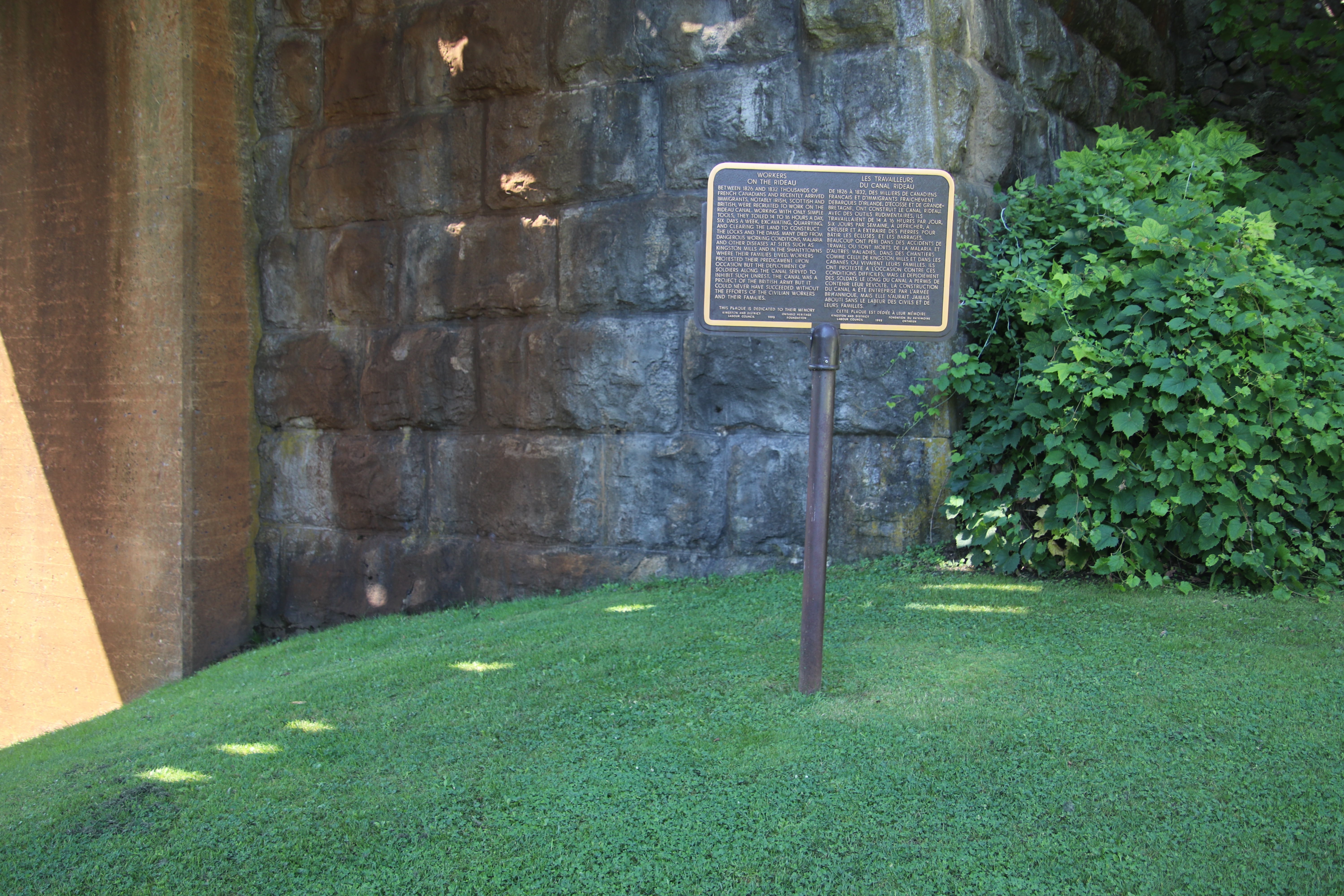
The plaque dedicated to workers on the Rideau stands under the railway bridge on the west side of the Rideau Canal at the Kingston Mills Lockstation.


WORKERS
ON THE RIDEAU


Between 1826 and 1832 thousands of French Canadians and recently arrived immigrants, notably Irish, Scottish and British, were recruited to work on the Rideau Canal. Working with only simple tools, they toiled 14 to 16 hours a day, six days a week, excavating, quarrying, and clearing the land to construct the locks and dams. Many died from dangerous working conditions, malaria and other diseases at sites such as Kingston Mills and in the shantytowns where their families lives. Workers protested their predicament upon occasion but the deployment of soldiers along the canal served to inhibit such unrest. The canal was a project of the British army but it could never have succeeded without the efforts of the civilian workers and their families.

This plaque is dedicated to their memory.

Kingston and District Labour Council
Ontario Heritage Foundation
1993
LES TRAVAILLEURS
DU CANAL RIDEAU


De 1826 à 1832, des milliers de canadiens français et d'immigrants fraichement débarques d'Irlande, d'Écosse et de Grande-Bretagne, ont construit le canal Rideau. Avec des outils rudimentaires, ils travaillaient de 14 à 16 heures par jour, six jours par semaine, à défricher, à creuser et à extraire des pierres pour bâtir les écluses et les barrages. Beaucoup ont péri dans des accidents de travail ou sont morts de la malaria et d'autres maladies, dans des chantiers comme celui de Kingston Mills et dans les cabanes où vivaient leurs familles. Ils ont protesté à l'occasion contre ces conditions difficiles, mais le déploiement des soldats le long du canal a permis de contenir leur révolte. La construction du canal a été entreprise par l'armée britannique, mais elle n'aurait jamais abouti sans le labour des civils et de leurs familles.

Cette plaque est dédiée à leur mémoire.

Kingston and District Labour Council
Fondation du Patrimoine Ontarien
1993