On the promenade overlooking the Rideau Canal on the southeast corner of Welington Street and Elgin Street stands a plaque commemorating Rail Heritage in Ottawa.
RAIL HERITAGE IN THE CAPITAL
The first rail line reached Ottawa (then Bytown) in 1854, opening the region to a new wave of commerce. By century's end, that track was part of a system reaching across Canada. in the heyday of rail, 10 companies operated in the Capital Region. In 1912, one of the largest among them — the Grand Trunk Railway — opened Central Station. This architectural splendour, later renamed Union Station opened its doors the same year as the Château Laurier, one of the many fine railway hotels built across Canada.
LE PATRIMOINE FERROVIAIRE DE LA CAPITALE
En 1854, une première voie ferée atteignait Ottawa (appelée alors « Bytown »), ouvrant ainsi une nouvelle ère de commerce pour la région. Moins de 50 ans plus tard, cette voie ferrée faisait partie d'un réseau qui traversait le Canada. Durant l'âge d'or des chemins de fer, 10 entreprises d'entre elles — la société Grand Trunk Railway — inaugurait la gare Centrale. Ce superbe édifice, rebaptisé par la suite la « gar Union », fut donc ouvert au public la même année que le Château Laurier, un des beaux hôtels ferroviaires qui jalonnent le Canada.
Thursday, October 04, 2018
Monday, October 01, 2018
Oscar Peterson Memorial Revisited
I photographed and posted about the Oscar Peterson Memorial in December 2012. I wanted to go back and photograph it again without the winter snow plow guards in place.
The Oscar Peterson Memorial occupies a place just outside the National Arts Centre on the northeast corner of Elgin Street and Albert Street.
OSCAR PETERSON
1925-2007
Oscar Peterson emerged from the Montréal working class neighbourhood known as Little Burgundy to become one of the world's greatest piano virtuosos. His place in the international jazz pantheon is universally recognized.
With this sculpture by Ruth Abernethy, Canada's Nationa Arts Centre proudly commemorates the masterful contribution Oscar Peterson made during his 65-year career as a musician, recording artist, composter and mentor.
Commissioned by teh Oscar Peterson Sculpture National Committee and the National Arts Centre.
This sculpture was unveiled by Her Majesty Queen Elizabeth II June 30, 2010.
OSCAR PETERSON
1925-2007
Du quartier ouvrier de la Petite-Bourgogne où il a grandi à Montréal, Oscar Peterson s'est hissé au rang des plus grands virtuoses du piano de la planète. Il est une figure universelle reconnue au panthéon international du jazz.
Par cette sculpture de Ruth Abernethy, le Centre national des Arts du Canada a voulu immortaliser fièrement la contribution remarquable qu'a apportée Oscar Peterson durant ses 65 ans de carrière comme musicien, artiste de disque, compositeur et mentor.
Œuvre commandée par le Comité national de la sculpture d'Oscar Peterson et le Centre national des Arts.
Cette sculpture a été dévollée par sa Majesté la reine Elizabeth II le 30 juin 2010.
A sound system incorporated into the sculpture plays recordings of Oscar Peterson's music.
The Oscar Peterson Memorial occupies a place just outside the National Arts Centre on the northeast corner of Elgin Street and Albert Street.
| Bösendorfer |
OSCAR PETERSON
1925-2007
Oscar Peterson emerged from the Montréal working class neighbourhood known as Little Burgundy to become one of the world's greatest piano virtuosos. His place in the international jazz pantheon is universally recognized.
With this sculpture by Ruth Abernethy, Canada's Nationa Arts Centre proudly commemorates the masterful contribution Oscar Peterson made during his 65-year career as a musician, recording artist, composter and mentor.
Commissioned by teh Oscar Peterson Sculpture National Committee and the National Arts Centre.
This sculpture was unveiled by Her Majesty Queen Elizabeth II June 30, 2010.
OSCAR PETERSON
1925-2007
Du quartier ouvrier de la Petite-Bourgogne où il a grandi à Montréal, Oscar Peterson s'est hissé au rang des plus grands virtuoses du piano de la planète. Il est une figure universelle reconnue au panthéon international du jazz.
Par cette sculpture de Ruth Abernethy, le Centre national des Arts du Canada a voulu immortaliser fièrement la contribution remarquable qu'a apportée Oscar Peterson durant ses 65 ans de carrière comme musicien, artiste de disque, compositeur et mentor.
Œuvre commandée par le Comité national de la sculpture d'Oscar Peterson et le Centre national des Arts.
Cette sculpture a été dévollée par sa Majesté la reine Elizabeth II le 30 juin 2010.
A sound system incorporated into the sculpture plays recordings of Oscar Peterson's music.
Thursday, September 27, 2018
Nelson Mandela Square
Nelson Mandela Square occupies the yard in front of the former Ottawa Teachers' College on the northeast corner of Elgin Street and Lisgar Street.
Nelson Mandela Square
This space, the front yard of Ottawa City Hall's Heritage Building and site of the Human Rights Monument, is named in honour of Nelson Mandela in recognition of his lifelong devotion to democracy and equality.
An internationally recognized leader who served as President of South Africa from 1994 to 1999, Mr. Mandela was South Africa's first black chief executive, and first elected in a fully representative democratic election. His government focused on dismantling the legacy of apartheid through tackling the institutionalized racism, poverty and inequality, and fostering racial reconciliation. In 1993, Nelson Mandela received the Nobel Peace Prize for his work towards the peaceful termination of the apartheid regime, and for laying the foundations for a new democratic South Africa.
In September 1998, Nelson Mandela visited the Human Rights Monument on this exact site.
In 2001, Nelson Mandela became the first living person to be made an honorary Canadian citizen and the first foreign leader with membership in the Order of Canada.
Approved by Ottawa City Council on April 9, 2014.
Place Nelson-Mandela
Cet espace, la cour avant de l'édifice historique de l'hôtel de ville d'Ottawa où se trouve le Monument des droits de la personne, est nommé en l'honneur de Nelson Mandela en reconnaissance de son dévouement constant evers la démocratie et l'égalité.
Chef de file mondialement reconnu et président de l'Afrique du Sud de 1994 à 1999, M. Mandela fut le premier dirigeant noir de ce pays élu lors d'un suffrage démocratique pleinement représenatif. Le gouvernement qu'il dirigea s'est consacré principalement au démantèlement de l'héritage de l'apartheid en s'attaquant au racisme institutionnalisé, à la pauvreté et à l'inégalité, tout en encourageant la réconciliation raciale. En 1993, Nelson Mandela a reçu le prix Nobel de la paix pour avoir contribué à mettre fin de manière pacifique au régime de l'apartheid, jetant les bases d'une Afrique du Sud démocratique.
En septembre 1998, Nelson Mandela a visité le Monument des droits de la personne à cet endroit précis.
En 2001, Nelson Mandela devenait la première personne encore vivante à recevoir la citoyenneté canadienne à titre honorifique et le premier dirigeant étranger à être investi de l'Ordre du Canada.
Approuvé par le Conseil municipal de la Ville d'Ottawa le 9 avril 2014.
Nelson Mandela Square
This space, the front yard of Ottawa City Hall's Heritage Building and site of the Human Rights Monument, is named in honour of Nelson Mandela in recognition of his lifelong devotion to democracy and equality.
An internationally recognized leader who served as President of South Africa from 1994 to 1999, Mr. Mandela was South Africa's first black chief executive, and first elected in a fully representative democratic election. His government focused on dismantling the legacy of apartheid through tackling the institutionalized racism, poverty and inequality, and fostering racial reconciliation. In 1993, Nelson Mandela received the Nobel Peace Prize for his work towards the peaceful termination of the apartheid regime, and for laying the foundations for a new democratic South Africa.
In September 1998, Nelson Mandela visited the Human Rights Monument on this exact site.
In 2001, Nelson Mandela became the first living person to be made an honorary Canadian citizen and the first foreign leader with membership in the Order of Canada.
Approved by Ottawa City Council on April 9, 2014.
Place Nelson-Mandela
Cet espace, la cour avant de l'édifice historique de l'hôtel de ville d'Ottawa où se trouve le Monument des droits de la personne, est nommé en l'honneur de Nelson Mandela en reconnaissance de son dévouement constant evers la démocratie et l'égalité.
Chef de file mondialement reconnu et président de l'Afrique du Sud de 1994 à 1999, M. Mandela fut le premier dirigeant noir de ce pays élu lors d'un suffrage démocratique pleinement représenatif. Le gouvernement qu'il dirigea s'est consacré principalement au démantèlement de l'héritage de l'apartheid en s'attaquant au racisme institutionnalisé, à la pauvreté et à l'inégalité, tout en encourageant la réconciliation raciale. En 1993, Nelson Mandela a reçu le prix Nobel de la paix pour avoir contribué à mettre fin de manière pacifique au régime de l'apartheid, jetant les bases d'une Afrique du Sud démocratique.
En septembre 1998, Nelson Mandela a visité le Monument des droits de la personne à cet endroit précis.
En 2001, Nelson Mandela devenait la première personne encore vivante à recevoir la citoyenneté canadienne à titre honorifique et le premier dirigeant étranger à être investi de l'Ordre du Canada.
Approuvé par le Conseil municipal de la Ville d'Ottawa le 9 avril 2014.
Monday, September 24, 2018
Victoria Cross Plaque
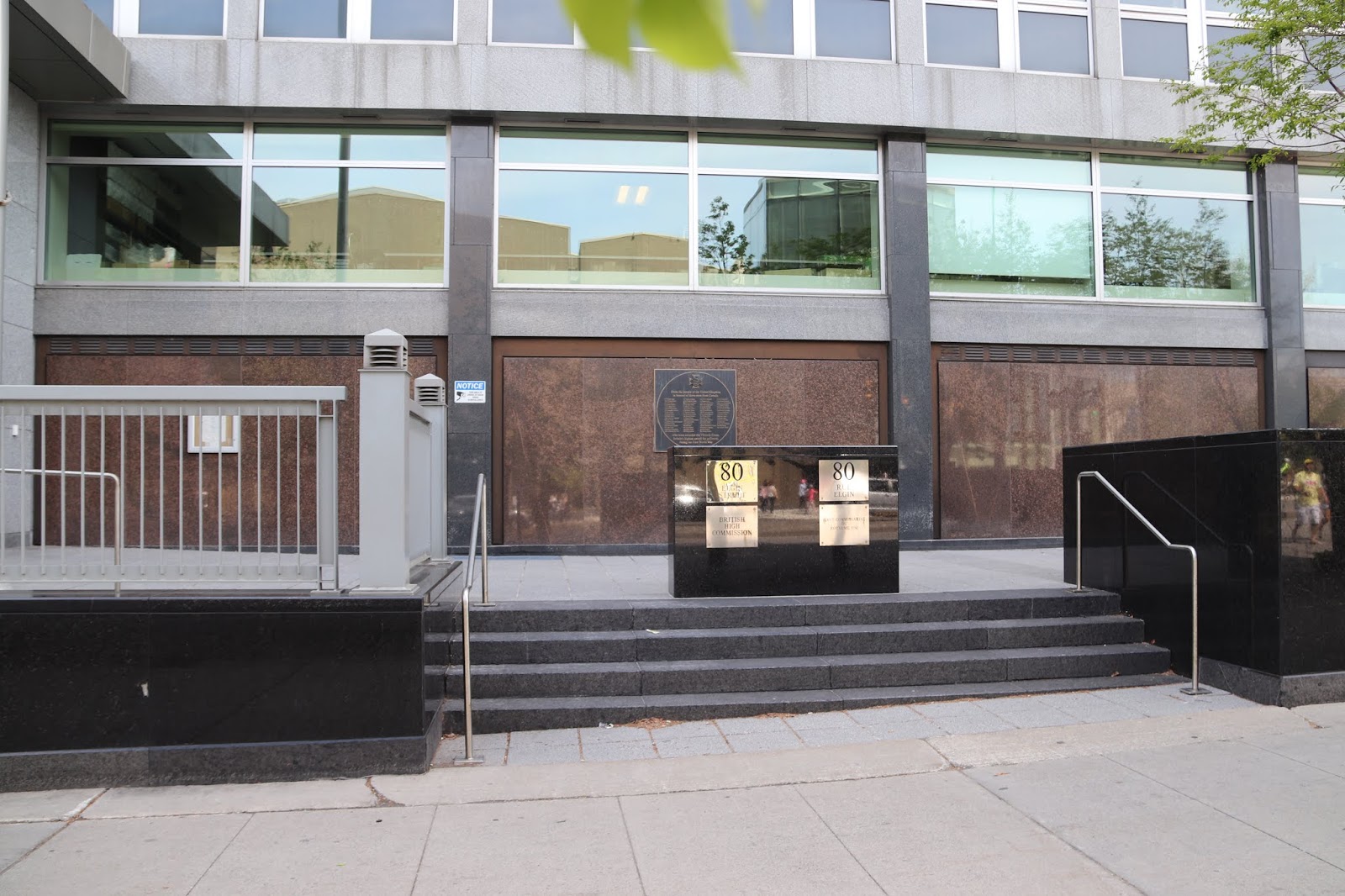
A plaque commemorating Canadians awarded the Victoria Cross during World War I occupies a place on the wall near the entrance of the British High Commission building on the southwest corner of Elgin Street and Queen Street.
| From the people of the United Kingdom in honour of those men from Canada who were awarded the Victoria Cross, Britain's highest award for gallantry, during the First World War |
Thursday, September 20, 2018
National Press Building Plaque
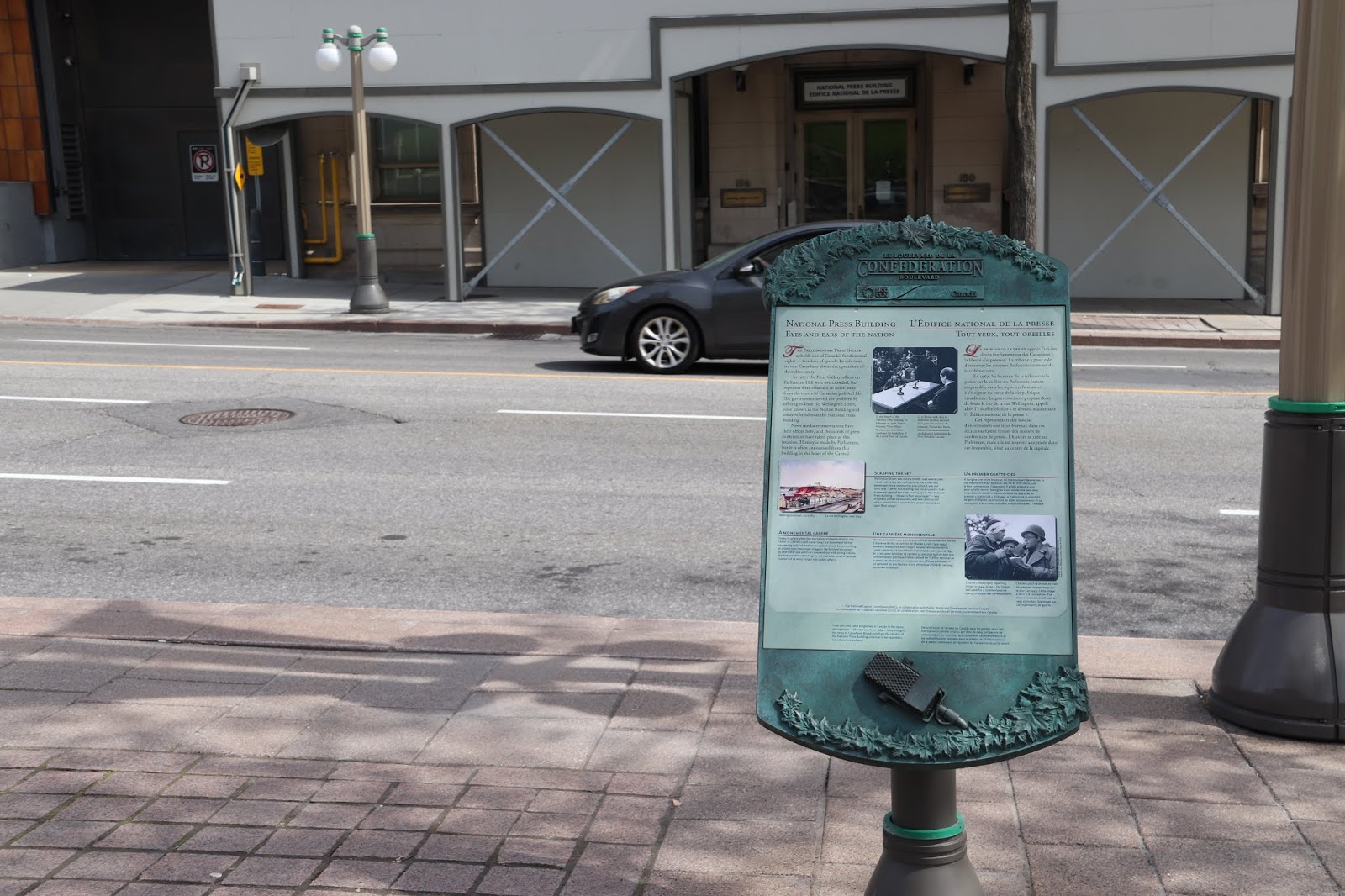
The plaque commemorating the National Press Building stands on the north side of Wellington Street, West of O'Connor Street and across the street from the National Press Building.
NATIONAL PRESS BUILDING
EYES AND EARS OF THE NATION
The Parliamentary Press Gallery upholds one of Canada's fundamental rights — freedom of speech. Its role is to inform Canadians about the operations of their democracy.
In 1967, the Press Gallery offices on Parliament Hill were overcrowded, but reporters were reluctant to move away from the centre of Canadian political life. The government solved the problem by offering to lease 150 Wellington Street, once known as the Norlite Building and today referred to as the National Press Building.
News media representatives have their offices here, and thousands of press conferences have taken place at this location. History is made by Parliament, but it is often announced from this building in the heart of the Capital.
The National Capital Commission (NCC), in collaboration with Public Works and Government Services Canada
L'ÉDIFICE NATIONAL DE LA PRESSE
TOUT YEUX, TOUT OREILLES
La tribune de la presse appuie l'un des droits fondamentaux des Canadiens : la liberté d'expression. La tribune a pour rôle d'informer les citoyens du fonctionnement de leur démocratie.
En 1967, les ureaux de la tribune de la presse sur la colline du Parlement étaient surpeuplés, mais les reporters hésitaient à s'éloigner du cœur de la vie politique canadienne. Le gouvernement proposa donc de louer le 150 de la rue Wellington, appelé alors l' « édifice Norlite » et denenu maintenant l' « Édifice national de la presse ».
Des représentants des médias d'information ont leurs bureaux dans ces locaux où furent tenues des milliers de conférences de presse. L'histoire se crée au Parlement, mais elle est souvent annoncée dans cet immeuble, situé au centre de la capitale.
La Commission de la capitale nationale (CNN), en collaboration avec Travaux publics et Services gouvernement aux Canada
NATIONAL PRESS BUILDING
EYES AND EARS OF THE NATION
The Parliamentary Press Gallery upholds one of Canada's fundamental rights — freedom of speech. Its role is to inform Canadians about the operations of their democracy.
In 1967, the Press Gallery offices on Parliament Hill were overcrowded, but reporters were reluctant to move away from the centre of Canadian political life. The government solved the problem by offering to lease 150 Wellington Street, once known as the Norlite Building and today referred to as the National Press Building.
News media representatives have their offices here, and thousands of press conferences have taken place at this location. History is made by Parliament, but it is often announced from this building in the heart of the Capital.
The National Capital Commission (NCC), in collaboration with Public Works and Government Services Canada
L'ÉDIFICE NATIONAL DE LA PRESSE
TOUT YEUX, TOUT OREILLES
La tribune de la presse appuie l'un des droits fondamentaux des Canadiens : la liberté d'expression. La tribune a pour rôle d'informer les citoyens du fonctionnement de leur démocratie.
En 1967, les ureaux de la tribune de la presse sur la colline du Parlement étaient surpeuplés, mais les reporters hésitaient à s'éloigner du cœur de la vie politique canadienne. Le gouvernement proposa donc de louer le 150 de la rue Wellington, appelé alors l' « édifice Norlite » et denenu maintenant l' « Édifice national de la presse ».
Des représentants des médias d'information ont leurs bureaux dans ces locaux où furent tenues des milliers de conférences de presse. L'histoire se crée au Parlement, mais elle est souvent annoncée dans cet immeuble, situé au centre de la capitale.
La Commission de la capitale nationale (CNN), en collaboration avec Travaux publics et Services gouvernement aux Canada
Monday, September 17, 2018
Treaty of Ghent Rose Garden
The Treaty of Ghent Rose Garden occupies a place on the south side of the entrance walkway to the former Ottawa Teacher's College on the northeast corner of Elgin Street and Lisgar Street.
1814 TREATY OF GHENT ROSE GARDEN
Unveiled on July 14, 2014 by His Excellency Bruno van der Pluijm, Amgassador of the Kingdom of Belgium and His Worship Jim Watson, Mayor of the City of Ottawa.
This rose garden, a gift from the Belgian Royal Society for Agriculture and Botany, commemorates the bicententary fo the Treaty of Ghent signed on December 24, 1814, bringing an end to the War of 1812. The Treaty of Ghent rose showcased in this gaarden is a variety created as the Ghent Flower Show of 1815 to honour the delegations negotiating the Treaty.
ROSERAIE TRAITÉ DE GAND DE 1814
Inaugurée le 14 juillet 2014 par Son Excellence Bruno van der Pluijm, ambassadeur du Royaume de Belguique et Son Honneur Jim Watson, maire de la Ville d'Ottawa.
Cette roseraie, don de la Société royale d'agriculture et de botanique de Belguique, commémore le bicentenaire de la signature, le 24 décembre 1814, du Traité de Gand, qui mit fin à la Guerre de 1812. La rose « Traité de Gand » mise en vedette dans cette roseraie est une variété créée à l'occasion de l'exposition florale de Gand en 1815 afin de rendre hommage aux délégations ayant négocié le Traité.
1814 VERDRAG VAN GENT ROZENTUIN
Ingehuldigd op 14 juli 2014 door Zijne Excellentie Bruno van der Pluijm, Ambassadeur van het Koninkrijk België en De Hoodedelachtbare Jim Watson, Burgemeester van de stad Ottawa.
Deze rozentuin is een gift van de Belgische Koninklijke Vereniging voor Landbouw en Plantkunde en heidenkt de 200ste verjaardag van het Verdrag van Gent, getekend op 24 December 1814, dat een einde bracht aan de Oorlog van 1812. De roos 'Verdrag van Gent' tentoongesteld in dese tuin is een variëteit die gecreëerd werd voor de Gentse Floraliën van 1815 ter ere van de delegaties die het Verdrag onderhandelden.
1814 TREATY OF GHENT ROSE GARDEN
Unveiled on July 14, 2014 by His Excellency Bruno van der Pluijm, Amgassador of the Kingdom of Belgium and His Worship Jim Watson, Mayor of the City of Ottawa.
This rose garden, a gift from the Belgian Royal Society for Agriculture and Botany, commemorates the bicententary fo the Treaty of Ghent signed on December 24, 1814, bringing an end to the War of 1812. The Treaty of Ghent rose showcased in this gaarden is a variety created as the Ghent Flower Show of 1815 to honour the delegations negotiating the Treaty.
ROSERAIE TRAITÉ DE GAND DE 1814
Inaugurée le 14 juillet 2014 par Son Excellence Bruno van der Pluijm, ambassadeur du Royaume de Belguique et Son Honneur Jim Watson, maire de la Ville d'Ottawa.
Cette roseraie, don de la Société royale d'agriculture et de botanique de Belguique, commémore le bicentenaire de la signature, le 24 décembre 1814, du Traité de Gand, qui mit fin à la Guerre de 1812. La rose « Traité de Gand » mise en vedette dans cette roseraie est une variété créée à l'occasion de l'exposition florale de Gand en 1815 afin de rendre hommage aux délégations ayant négocié le Traité.
1814 VERDRAG VAN GENT ROZENTUIN
Ingehuldigd op 14 juli 2014 door Zijne Excellentie Bruno van der Pluijm, Ambassadeur van het Koninkrijk België en De Hoodedelachtbare Jim Watson, Burgemeester van de stad Ottawa.
Deze rozentuin is een gift van de Belgische Koninklijke Vereniging voor Landbouw en Plantkunde en heidenkt de 200ste verjaardag van het Verdrag van Gent, getekend op 24 December 1814, dat een einde bracht aan de Oorlog van 1812. De roos 'Verdrag van Gent' tentoongesteld in dese tuin is een variëteit die gecreëerd werd voor de Gentse Floraliën van 1815 ter ere van de delegaties die het Verdrag onderhandelden.
Thursday, September 13, 2018
Ashbury College Founding Plaque
On the southeast corner of Wellington Street and O'Connor Street on the wall of 140 Wellington Street a plaque commemorates the founding of Ashbury College.
Subscribe to:
Posts (Atom)