| AT THE GOING DOWN OF THE SUN AND IN THE MORNING WE WILL REMEMBER THEM. KOREA 1950 — 1953 |
Tuesday, July 18, 2017
The Prescott Cenotaph
The Prescott Cenotaph occupies a place just south of the Fort Wellington visitors parking lot east of Vankoughnet Street and North of King Street East in Prescott, Ontario.
Thursday, July 13, 2017
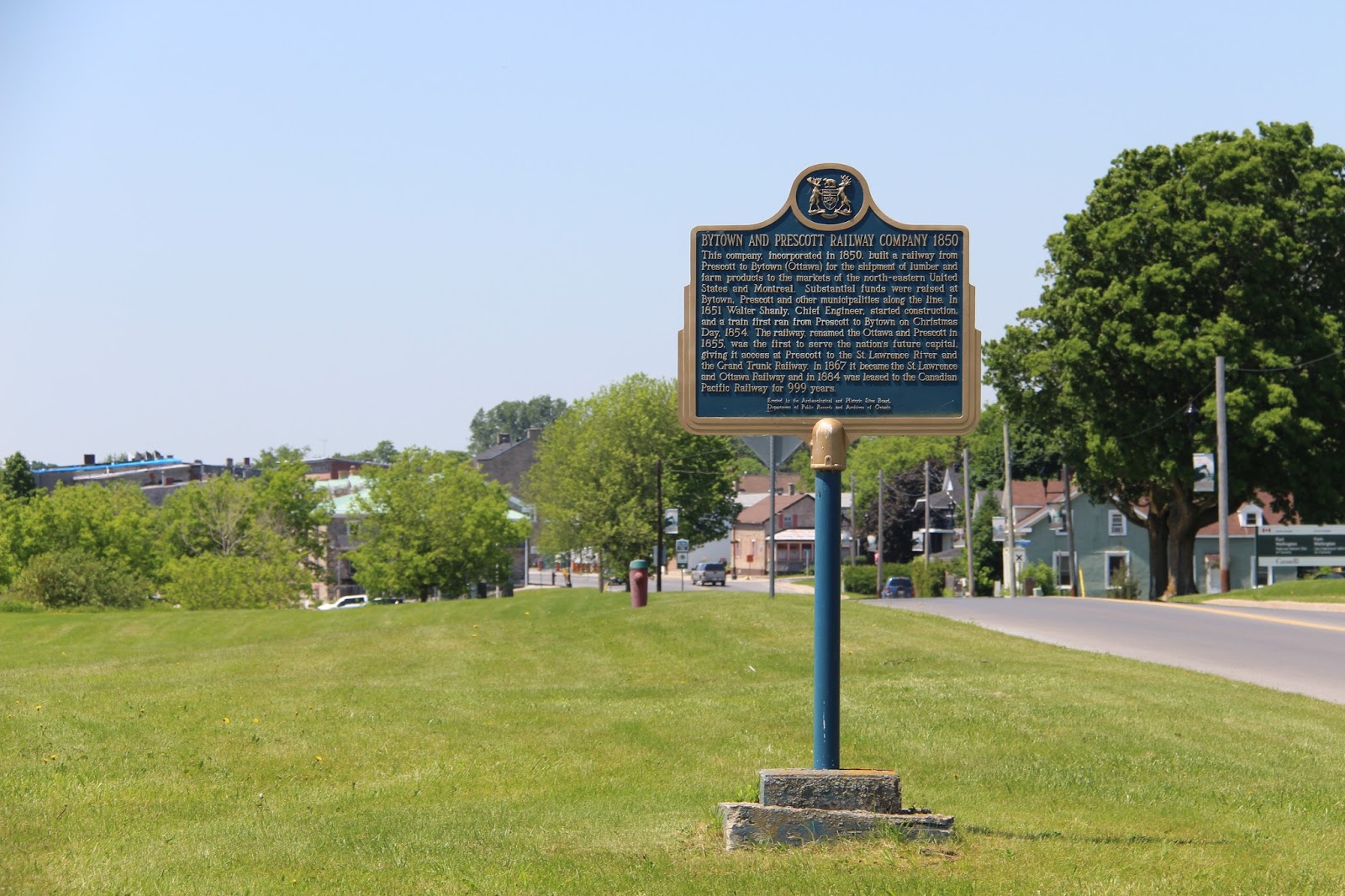
Bytown and Prescott Railway Company Plaque
In Prescott, Ontario, a plaque commemorating the Bytown and Prescott Railway stands south of King Street East and west of Russel Street across from Fort Wellington.
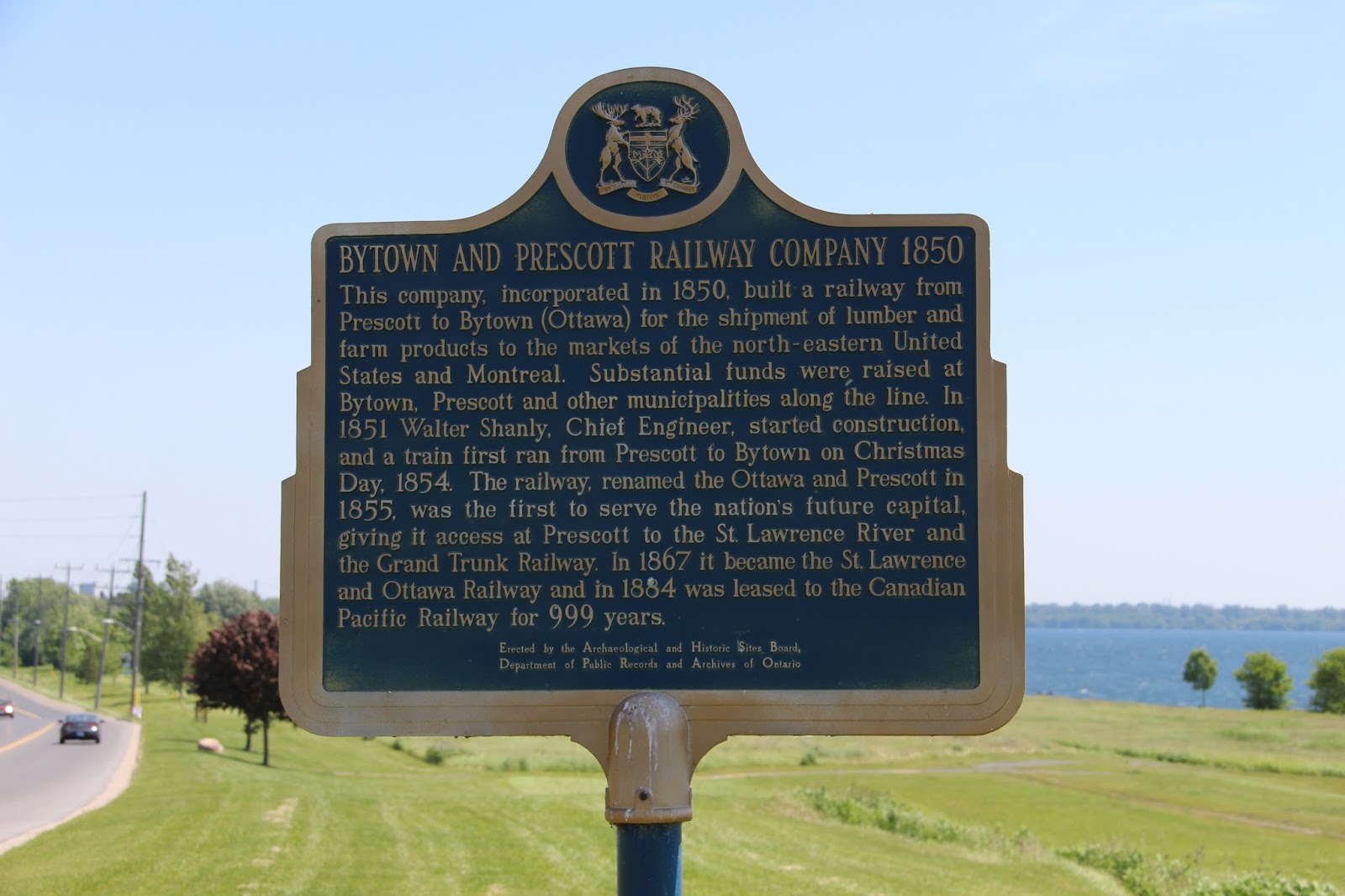
BYTOWN AND PRESCOTT RAILWAY COMPANY 1850
This company, incorporated in 1850, built a railway from Prescott to Bytown (Ottawa) for the shipment of lumber and farm products to the markets in the north-eastern United States and Montreal. Substantial funds were raised at Bytown, Prescott and other municipalities along the line. In 1851 Walter Shanly, Chief Engineer, started construction, and a train first ran from Prescott to Bytown on Christmas Day, 1854. The railway, renamed the Ottawa and Prescott in 1855, was the first to serve the nation's future capital, giving it access to the St. Lawrence River and the Grand Trunk Railway. In 1867 it became the St. Lawrence and Ottawa Railway and in 1884 was leased to the Canadian Pacific Railway for 999 years.
Erected by the Archaeological and Historic Sites Board,
Department of Public Records and Archives of Ontario
BYTOWN AND PRESCOTT RAILWAY COMPANY 1850
This company, incorporated in 1850, built a railway from Prescott to Bytown (Ottawa) for the shipment of lumber and farm products to the markets in the north-eastern United States and Montreal. Substantial funds were raised at Bytown, Prescott and other municipalities along the line. In 1851 Walter Shanly, Chief Engineer, started construction, and a train first ran from Prescott to Bytown on Christmas Day, 1854. The railway, renamed the Ottawa and Prescott in 1855, was the first to serve the nation's future capital, giving it access to the St. Lawrence River and the Grand Trunk Railway. In 1867 it became the St. Lawrence and Ottawa Railway and in 1884 was leased to the Canadian Pacific Railway for 999 years.
Erected by the Archaeological and Historic Sites Board,
Department of Public Records and Archives of Ontario
Monday, July 10, 2017
Prescott Barracks and Hospital
In Prescott, Ontario, a stone fronted building on the east side of East Street and about midway between Dibble Street East and Henry Street East, has a plaque standing nearby, south of it, explaining its provenance.
PRESCOTT BARRACKS AND HOSPITAL
The front portion of this structure, one of the earliest surviving military buildings in Ontario, was constructed as a residence about 1810 by Colonel Edward Jessup, the founder of Prescott. Following the outbreak of the War of 1812, the stone house was appropriated for use as a barracks by local militia and, later, British regulars. It was soon enclosed within a stockade with other buildings, including a log schoolhouse also converted for barracks. Although a fort was completed nearby in 1814, the Jessup building continued to form part of the strategically located Prescott garrison. Between 1815 and 1817 it served as a combined hospital and barracks store, and in 1823 the British force purchased the house from the Jessup family.
ERECTED BU THE ONTARIO HERITAGE FOUNDATION,
MINISTRY OF CULTURE AND RECREATION
PRESCOTT BARRACKS AND HOSPITAL
The front portion of this structure, one of the earliest surviving military buildings in Ontario, was constructed as a residence about 1810 by Colonel Edward Jessup, the founder of Prescott. Following the outbreak of the War of 1812, the stone house was appropriated for use as a barracks by local militia and, later, British regulars. It was soon enclosed within a stockade with other buildings, including a log schoolhouse also converted for barracks. Although a fort was completed nearby in 1814, the Jessup building continued to form part of the strategically located Prescott garrison. Between 1815 and 1817 it served as a combined hospital and barracks store, and in 1823 the British force purchased the house from the Jessup family.
ERECTED BU THE ONTARIO HERITAGE FOUNDATION,
MINISTRY OF CULTURE AND RECREATION
Thursday, July 06, 2017
Ray & Eleanor Mills U.E.L. Bench
A bench memorializing Ray and Eleanor Mills occupies a place in Caroline's Garden, in Millennium Park, on the northeast corner of County Roads 2 and 16, in Johnstown, Ontario.
| IN LOVING MEMORY OF RAY & ELEANOR MILLS U.E.L. DONATED BY THE LAWLESS FAMILY |
Monday, July 03, 2017
First Court House and Gaol Plaque
A plaque commemorating Eastern Ontario's first court house and gaol, stands in Millennium Park on the northeast corner of County Road 16 and County Road 2 in Johnstown, Ontario. Visitors will find the plaque in the park at the western edge of Caroline's Garden.
Une plaque commémorative du premier palais de justice et de la première prison de l'Est de l'Ontario se trouve dans le parc du Millénaire, à l'angle nord-est du chemin de comté 16 et du chemin de comté 2, à Johnstown, en Ontario. Les visiteurs pourront la trouver à l'extrémité ouest du jardin Caroline.
Eastern Ontario's first Court House and Gaol was constructed on the waterfront south of this site between 1795 and 1797. The complex included a chamber for the District Court on the upper floor as well as cells and a room for the jailer on the lower level. Later a pillory and stocks were erected next to the Court House. The entire area was enclosed with a picket fence constructed with cedar posts eight feet high. In 1810 the Court and Gaol were moved to new facilities in Brockville, despite the vehement protest of the Johnstown citizens. The structure later served as a place of public worship and as a barracks and gaol during the War of 1812. It fell into a state of disrepair and eventually burned to the ground in 1875.
Une plaque commémorative du premier palais de justice et de la première prison de l'Est de l'Ontario se trouve dans le parc du Millénaire, à l'angle nord-est du chemin de comté 16 et du chemin de comté 2, à Johnstown, en Ontario. Les visiteurs pourront la trouver à l'extrémité ouest du jardin Caroline.
Eastern Ontario's first Court House and Gaol was constructed on the waterfront south of this site between 1795 and 1797. The complex included a chamber for the District Court on the upper floor as well as cells and a room for the jailer on the lower level. Later a pillory and stocks were erected next to the Court House. The entire area was enclosed with a picket fence constructed with cedar posts eight feet high. In 1810 the Court and Gaol were moved to new facilities in Brockville, despite the vehement protest of the Johnstown citizens. The structure later served as a place of public worship and as a barracks and gaol during the War of 1812. It fell into a state of disrepair and eventually burned to the ground in 1875.
ERECTED BY THE GRENVILLE COUNTY HISTORICAL SOCIETY
WITH THE ASSISTANCE OF THE ONTARIO HERITAGE FOUNDATION
AND SOUTH EDWARDSBURGH RECREATION ASSOCIATION
WITH THE ASSISTANCE OF THE ONTARIO HERITAGE FOUNDATION
AND SOUTH EDWARDSBURGH RECREATION ASSOCIATION
Le premier palais de justice et la première prison de l'Est de l'Ontario furent construits sur le front de mer, au sud de cet emplacement, entre 1795 et 1797. Le complexe comprenait une salle d'audience pour le tribunal de district à l'étage, ainsi que des cellules et une pièce pour le geôlier au rez-de-chaussée. Plus tard, un pilori et des ceps furent installés à côté du palais de justice. L'ensemble du site était entouré d'une clôture de piquets de cèdre de 2,4 mètres de haut. En 1810, le tribunal et la prison furent transférés dans de nouveaux locaux à Brockville, malgré les vives protestations des citoyens de Johnstown. L'édifice servit par la suite de lieu de culte public, puis de caserne et de prison durant la guerre de 1812. Tombé en ruine, il fut finalement entièrement détruit par un incendie en 1875.
ÉRIGÉ PAR LA SOCIÉTÉ HISTORIQUE DU COMTÉ DE GRENVILLE
AVEC L'AIDE DE LA FONDATION DU PATRIMOINE DE L'ONTARIO
ET DE L'ASSOCIATION DE LOISIRS DE SOUTH EDWARDSBURGH
AVEC L'AIDE DE LA FONDATION DU PATRIMOINE DE L'ONTARIO
ET DE L'ASSOCIATION DE LOISIRS DE SOUTH EDWARDSBURGH
Saturday, July 01, 2017
Browns Bay British Gunboat
The Fort Wellington Visitors' Centre, on the east side of Vankoughnet Street in Prescott, Ontario, houses the excavated remains of a large wooden boat used by the Royal Navy in Canada during the War of 1812 and later, the Upper-Canada Rebellion of 1838-1839.
Gunboat to Workboat
You are looking at the remains of what is thought to be a British gunboat. In 1967, Parks Canada's Underwater Archaeology Service raised this submerged shipwreck from Brown's Bay, Ontario, on the St. Lawrence River about 40 km (25 mi.) west of Prescott. It measures roughly 16.5 m (54 ft.) long and 4.9 m (16 ft.) wide. Ice movement likely tore away the upper decking and part of the bow, leaving only these remains.
It is believed that the boat was built originally as a Royal Navy gunboat in the early 1800s but the exact identification is still uncertain.
Evidence shows that the boat was modified for use as a merchant cargo vessel before it was abandoned in Brown's Bay.
De cannonnière à bateau commercial
Vous avez devant vous les vestiges de ce qu'on croit être une cannonière britannique. En 1967, le Service d'archéologie subaquatique de Parcs Canada a retiré cette épave de la baie Brown située sur le fleuve Saint-Laurent en Ontario, à l'ouest de Prescott. Elle mesute environ 16,5 m (54 pi) de long et 4,9 m (16 pi) de large. Ce sont probablement des mouvements de la glace qui ont arraché le pont supérieur et une partie de la proue, n'épargnant que ces vestiges.
Ce bateau fut probablement construit au début du XIXe siècle afin de servir de canonnière la Marine royale britannique, mais son identité exacte est toujours incertaine.
Des preuves archéologiques indiquent que le bateau fut modifié pour servir comme navire marchand avant d'être finalement abandonné dans la baie Brown.
In the boat's display room there is a reserch bulletin (No. 307) available in English and French titled, The Browns Bay Vessel: Its Design and Construction / Le navire de la baie Browns : sa conception et sa contstruction by Chris Amer, Marine Archaeology Unit, Ottawa, September 1994, Candian Heritage, Parks Canada / Patrimoine canadien, Parcs Canada.
The bulletin details the excavation and investigation of the boat with an analysis that explains the conclusion that the boat was a Royal Navy gunboat that was later sold and modified into a commercial vessel.
"The significance of the Browns Bay Vessel is vast. It is, at present, the only known Royal Navy flat-bottomed boat that dates to the period of the War of 1812. The fact that the hull shows repairs and major modifications attaches additional significance to this unique craft. Little is currently known of the extent that British Naval vessels from that period in Canada were used after their military roles had ceased. Many of the boats were evidently broken up for their fastenings or were left to decay, while some were sold and apparently operated commercially. While the subject has been previously addressed, the Browns Bay Vessel holds the only evidence for the continued use of such a boat."
The Browns Bay Vessel: Its Design and Construction
« L'intéret du navire de la baie Browns est considérable. C'est actuellement le seul bateau à fond plat connu de la Marine royale qui remonte à l'époque de la guerre d 1812. Le fait que la coque monte des signes de réparations et de considérable modifications ne fait que renforcer l'intéret de ce navire exceptionnel. On ne sait trop actuellement à quel point les navires de guerre britanniques présents à cette époque au Canada ont été utilisés une fois leur rôle militaire terminé. Beaucoup ont de toute évidence été démontés par ceux qui voulaient récupérer leur chevillage ou laissés à leur délabrement, mais certains ont été vendus et exploités commercialement. Le sujet déjà été abordé, mais le navire de la baie Browns est le seul témoignage de la poursuite de l'utilisation d'un bâtiment de ce genre. »
Le navire de la baie Browns : sa conception et sa construction
"A number of hull fittings and artifacts were recovered from within the hull. Artifacts recovered amidships included two fragments of chainplates as well as two forelocked eye-bolts, several single sheaved blocks and a sheave. Other artifacts included a caulking hammer, a chisel, a whetstone, a leather boot and two shovels which were excavated from the forward section of the hull."
The Browns Bay Vessel: Its Design and Construction
« Plusieurs accessoires de la coque et artefacts ont été retrouvés dans la coque. Parmi les artefacts récupérés au milieu du navire, citons deux fragments de cadène, ainsi que deux pitons à oeil à goupille, plusieurs poulies à réa et un réa. On a également extrait de la section avant de la coque un matoir, un ciseau, une pierre à aiguiser, une botte de cuir et deux pelles. »
Le navire de la baie Browns : sa conception et sa construction
Gunboat to Workboat
You are looking at the remains of what is thought to be a British gunboat. In 1967, Parks Canada's Underwater Archaeology Service raised this submerged shipwreck from Brown's Bay, Ontario, on the St. Lawrence River about 40 km (25 mi.) west of Prescott. It measures roughly 16.5 m (54 ft.) long and 4.9 m (16 ft.) wide. Ice movement likely tore away the upper decking and part of the bow, leaving only these remains.
It is believed that the boat was built originally as a Royal Navy gunboat in the early 1800s but the exact identification is still uncertain.
Evidence shows that the boat was modified for use as a merchant cargo vessel before it was abandoned in Brown's Bay.
De cannonnière à bateau commercial
Vous avez devant vous les vestiges de ce qu'on croit être une cannonière britannique. En 1967, le Service d'archéologie subaquatique de Parcs Canada a retiré cette épave de la baie Brown située sur le fleuve Saint-Laurent en Ontario, à l'ouest de Prescott. Elle mesute environ 16,5 m (54 pi) de long et 4,9 m (16 pi) de large. Ce sont probablement des mouvements de la glace qui ont arraché le pont supérieur et une partie de la proue, n'épargnant que ces vestiges.
Ce bateau fut probablement construit au début du XIXe siècle afin de servir de canonnière la Marine royale britannique, mais son identité exacte est toujours incertaine.
Des preuves archéologiques indiquent que le bateau fut modifié pour servir comme navire marchand avant d'être finalement abandonné dans la baie Brown.
| The model shows how the boat may have looked during its use as a gunboat. Le maquette représente le bateau lors de son utilisation en tant que canonnière. |
In the boat's display room there is a reserch bulletin (No. 307) available in English and French titled, The Browns Bay Vessel: Its Design and Construction / Le navire de la baie Browns : sa conception et sa contstruction by Chris Amer, Marine Archaeology Unit, Ottawa, September 1994, Candian Heritage, Parks Canada / Patrimoine canadien, Parcs Canada.
The bulletin details the excavation and investigation of the boat with an analysis that explains the conclusion that the boat was a Royal Navy gunboat that was later sold and modified into a commercial vessel.
"The significance of the Browns Bay Vessel is vast. It is, at present, the only known Royal Navy flat-bottomed boat that dates to the period of the War of 1812. The fact that the hull shows repairs and major modifications attaches additional significance to this unique craft. Little is currently known of the extent that British Naval vessels from that period in Canada were used after their military roles had ceased. Many of the boats were evidently broken up for their fastenings or were left to decay, while some were sold and apparently operated commercially. While the subject has been previously addressed, the Browns Bay Vessel holds the only evidence for the continued use of such a boat."
The Browns Bay Vessel: Its Design and Construction
« L'intéret du navire de la baie Browns est considérable. C'est actuellement le seul bateau à fond plat connu de la Marine royale qui remonte à l'époque de la guerre d 1812. Le fait que la coque monte des signes de réparations et de considérable modifications ne fait que renforcer l'intéret de ce navire exceptionnel. On ne sait trop actuellement à quel point les navires de guerre britanniques présents à cette époque au Canada ont été utilisés une fois leur rôle militaire terminé. Beaucoup ont de toute évidence été démontés par ceux qui voulaient récupérer leur chevillage ou laissés à leur délabrement, mais certains ont été vendus et exploités commercialement. Le sujet déjà été abordé, mais le navire de la baie Browns est le seul témoignage de la poursuite de l'utilisation d'un bâtiment de ce genre. »
Le navire de la baie Browns : sa conception et sa construction
"A number of hull fittings and artifacts were recovered from within the hull. Artifacts recovered amidships included two fragments of chainplates as well as two forelocked eye-bolts, several single sheaved blocks and a sheave. Other artifacts included a caulking hammer, a chisel, a whetstone, a leather boot and two shovels which were excavated from the forward section of the hull."
The Browns Bay Vessel: Its Design and Construction
« Plusieurs accessoires de la coque et artefacts ont été retrouvés dans la coque. Parmi les artefacts récupérés au milieu du navire, citons deux fragments de cadène, ainsi que deux pitons à oeil à goupille, plusieurs poulies à réa et un réa. On a également extrait de la section avant de la coque un matoir, un ciseau, une pierre à aiguiser, une botte de cuir et deux pelles. »
Le navire de la baie Browns : sa conception et sa construction
Subscribe to:
Posts (Atom)