Monday, December 19, 2022

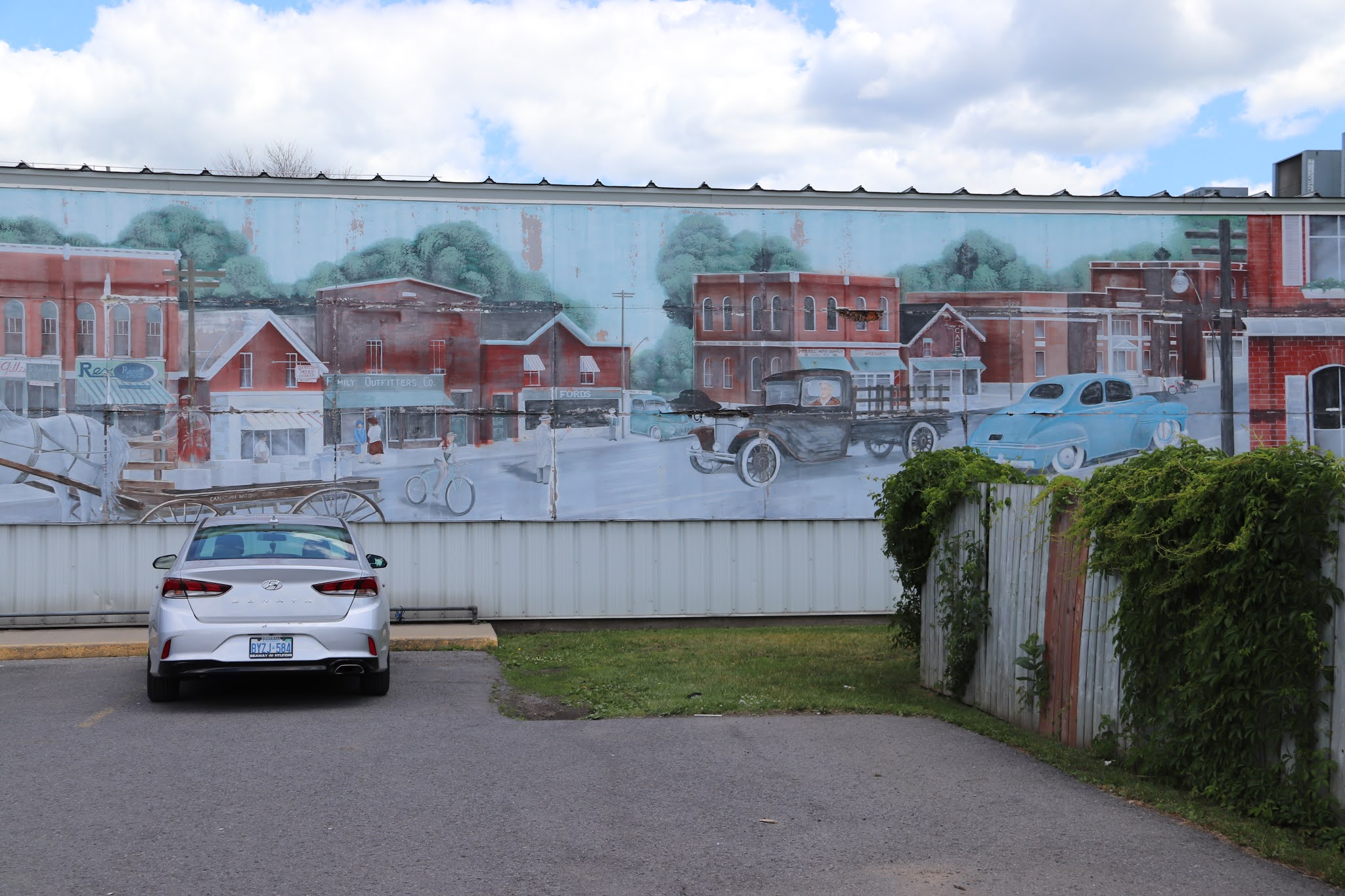
North Side Main St. Mural

In Morrisburg the North Side Main Street Mural occupies the outside west wall of the Giant Tiger store on the southwest corner of St. Lawrence Street and County Road 2.


Kelly 2003

DUNDAS MURALS

NORTH SIDE MAIN ST.

This scene of the north side of Main Street in Morrisburg at the start of the second world war combines the horse and cart with the automobile. The Cassleman Dace Hall, the shoe store, the Five and Dime stores, the local hardware store, the drugstore and the butcher shop represent the local independent small town merchant so typical of that era.


Monday, December 12, 2022

Sheila M. Stanley Bench

In Greely, Ontario, the bench commemorating Sheila M. Stanley occupies the grounds of All Saints Anglican Church on the northwest corner of Parkway Road and Pig Alley.


In Memory of
Sheila M. Stanley
1941-2016

Daughter of
Norman and Margaret
Stanley
Wife of Richard D. Waite
Resting in Ayer's Cliff, QC


Monday, December 05, 2022

Major W. Ross Chamberlain Park

In Manotick, Ontario, the park commemorating Major W. Ross Chamberlain occupies the northeast corner of Alabaster Heights and Bridgeport Avenue.

Major W. Ross Chamberlain Park

Parc du Major-W.-Ross-Chamberlain


Major W. Ross Chamberlain Park

This park is named in commemoration of Major W. Ross Chamberlain for his outstanding service to his community and country.

A celebrated military war veteran, former educator, active legionnaire and leader within his community, Ross Chamberlain dedicated his time to enriching the lives of others around him. Ross began his military career in 1942 with the Services Corps before moving on to the IV Princess Louise Dragoon Guards. He served and represented Canada throughout World War II. His skilful and distinguished leadership was recognized when he received a Military Cross and Italian Star for his service.

After retiring from the military, Ross went on to pursue a successful teaching career, eventually becoming a guidance counsellor. After retiring from teaching, Ross devoted his time to his community, leading many initiatives and projects to improve the lives of seniors. An active member of the Royal Canadian Legion Branch 314 South Carleton (Manotick), Ross exemplified remarkable service. He was a fine example of dedication and bravery, and his community is grateful for his service and contributions.

Approved by Ottawa City Council on January 23, 2013.
Mayor Jim Watson
Councillor Scott Moffatt (Rideau-Goulbourn)

Parc du Major-W.-Ross-Chamberlain

Ce parc est nommé en hommage au Major W. Ross Chamberlain pour les services exceptionnels qu'il a rendus à sa communauté et à son pays.

Militiare connu ayant combattu à la guerre, ancien éducateur, membre actif de la Légion et chef de file de sa communauté, Ross Chamberlain s'est employé à enrichir la vie des gens autour de lui. Il a entrepris sa carrière militiare en 1942 dans le Corps de l'intendance de l'Armée, avant de se joindre aux IV Princess Louise Dragoon Guards. Il a servi et représenté le Canada tout au long de la Deuxième Guerre mondiale. Son leadership compétent et remarquable lui a value la Croix militaire et l'Étoile italienne.

Après avoir quitté l'armée, M. Chamberlain a fait une fructueuse carrière dans l'enseignement et en est venu à occuper un poste de conseiller d'orientation. À sa retraite il s'est consacré à sa caommunauté, menant de nombreux projets et initiatives destinée à améliorer la vie des aînés. Membre actif de la section 314 de la Légion royale canadienne de South Carleton (Manotick), M. Chamberlain incarnait la notion de service. Il a été un magnifique example de dévouement et de courage, et sa communauté lui est reconnaissante de ses services et ses contributions.

Approuvé par le Conseil municipal d'Ottawa le 23 janvier 2013.
Maire Jim Watson
Conseiller Scott Moffatt (Rideau-Goulbourn)


Monday, November 28, 2022

Rafting & Fire Rage Plaques

Two plaques about rafting on the Ottawa River and fires in LeBreton Flats occupy a location on the south shore of the Ottawa River, north of the Ottawa River Pathway east of where Booth Street ends and Chaudière Crossing begins.


Rafting the Ottawa River

LeBreton Flats was a key stopping point and industrial centre for the raftsmen and timber rafts that travelled the river. The rafts were not as manoeuvrable as a conventional boat, and loggers had to navigate difficult waters as they floated the wood down to the industrial complex at LeBreton Flats.

Standing here at the edge of the river in the early 19th century, you would have seen giant rafts of squared timber coming down the Ottawa River.


Les trains de flottage sur la rivière des Outaouais

Les plaines LeBreton étaient un centre industriel important et un poste d'arrêt essential pour les flotteurs (ou encore « draveurs » ou « cageux », selon des expressons populaires) ainsi que leurs trains de bois flottants qui descendaient la rivière. Ces trains de flottage n'offraient pas la facilité de navigation des bateaux, et les bùcherons devaient navigeur dans des eaux difficiles en dirigeant le bois vers le bomplexe industriel des plaines LeBreton.

Si vous aviez été ici, au bord de la rivière au début du 19e siècle, vous auriez vu d'immenses radeaux de bois équarri descendre la rivière des Outaouais.
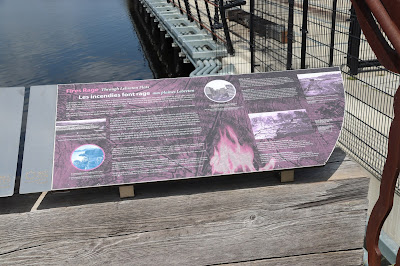
Fires Rage Through LeBreton Flats

LeBreton Flats was the heart of the lumber industry in the Ottawa River Valley. The area was dominated by wood piles, sawmills and freight sheds, and included a mix of wood-frame homes. Fires were one of the greatest perils not only to the citizens of Le Breton Flats, but also to the lumber industry in the nation's Capital. Between 1890 and 1903, there were five major fires that severely damaged industrial and residential areas in LeBreton Flats.

Yet, as a residential centre in an industrial zone, LeBreton Flats was a symbol of the heartiness and toughness of its occupants who rebuilt time and time again after the conflagrations of the 19th and early 20th centuries.


Les incendies font rage aux plaines LeBreton


Les plaines Le Breton étaient le centre de l'industrie du bois dans la vallée de l'Outaouais. Elles étaient donc envahies par quantité de piles de bois d'œuvre, de nombreuses scieries, et entrepôts de marchandises auxquels se mêlaient les maisons à ossature de bois. Les incendies étaient l'un des plus grands dangers, non seulement pour les habitants des plaines, mais aussi pour l'industrie du bois dans la capitale du pays. Entre 1890 et 1903, cinq incendies importants ont ravagé les secteurs industriels et résidentiels des plaines LeBreton.

Aussi, les plaines Le Breton, qui étaient un centre résidentiel dans une zone industrielle, furent-elles un symbole de la robustesse et de la résistance de ses habitants qui reconstruisirent maintes et maintes fois après chaque incendie du 19e siècle et du début du 20e siècle.

View of LeBreton Flats looking toward the Ottawa River, after the fire of April 26, 1900
Booth Family Collection, Library and Archives Canada, PA 121784


Vue des plaines LeBreton vers la rivière des Outaouais, après l'incendie du 26 avril 1900.
Collection de la famille Booth, Bibliothèque et Archives Canada, PA 121784