À Prescott, en Ontario, le Musée des transitaires occupe l'angle sud-ouest de la rue Water Ouest et de la rue Centre. À proximité, à l'ouest du musée, se trouve une plaque intitulée « Le commerce des transitaires à Prescott ».

What's Forwarding?
Forwarding is the business carried out by a person or company called a forwarding agent, a freight forwarder or a forwarder. The forwarding agent organizes shipments to get goods from a manufacturer or producer to a market, customer or a final destination for distribution. Most of the work forwarders do involves transportation logistics and the handling of documentation related to the movement of goods, including invoices, bills of lading, and documents for moving goods across international borders.
Qu'est-ce que le transport de marchandises?
Le transport de marchandises est l'activité exercée par une personne ou une entreprise appelée transitaire. Le transitaire organise l'expédition des marchandises d'un fabricant ou producteur jusqu'à un marché, un client ou une destination finale de distribution. La majeure partie du travail des transitaires consiste en la logistique du transport et la gestion des documents relatifs au mouvement des marchandises, notamment les factures, les connaissements et les documents nécessaires au passage des frontières internationales.


THE FORWARDING TRADE AT PRESCOTT
Before the completion of the canals between here (Prescott) and Montreal in 1847, Prescott was the eastern terminus of Great Lakes navigation. Established at the head of Galops Rapids in 1810, it soon became a centre for the forwarding, or shipping, trade and an important centre in Montreal's commercial system. One of the earliest forwarders at Prescott was Captain William Gilkison, who began operations on this property about 1811. As the population of Upper Canada increased rapidly after 1820, the trade expanded and forwarding firms, including Henderson & Hooker and Macpherson, Crane & Co., established shipbuilding yards, wharfs, and warehouses along this waterfront. Prescott's position in the forwarding trade began to decline in 1847 when uninterrupted navigation from Montreal to Lake Ontario became possible.
Erected by the Ontario Heritage Foundation, Ministry of Culture and Recreation

Avant l'achèvement des canaux reliant Prescott à Montréal en 1847, Prescott était le terminus oriental de la navigation sur les Grands Lacs. Établie en 1810 à l'embouchure des rapides de Galops, elle devint rapidement un centre névralgique du commerce de transport et un pôle important du système commercial montréalais. L'un des premiers transitaires à Prescott fut le capitaine William Gilkison, qui y débuta ses activités vers 1811. Avec la croissance démographique rapide du Haut-Canada après 1820, le commerce se développa et des entreprises de transit, dont Henderson & Hooker et Macpherson, Crane & Co., établirent des chantiers navals, des quais et des entrepôts le long du front de mer. L'importance de Prescott dans le commerce de transport commença à décliner en 1847, lorsque la navigation directe de Montréal au lac Ontario devint possible.
Érigé par la Fondation du patrimoine ontarien, ministère de la Culture et des Loisirs


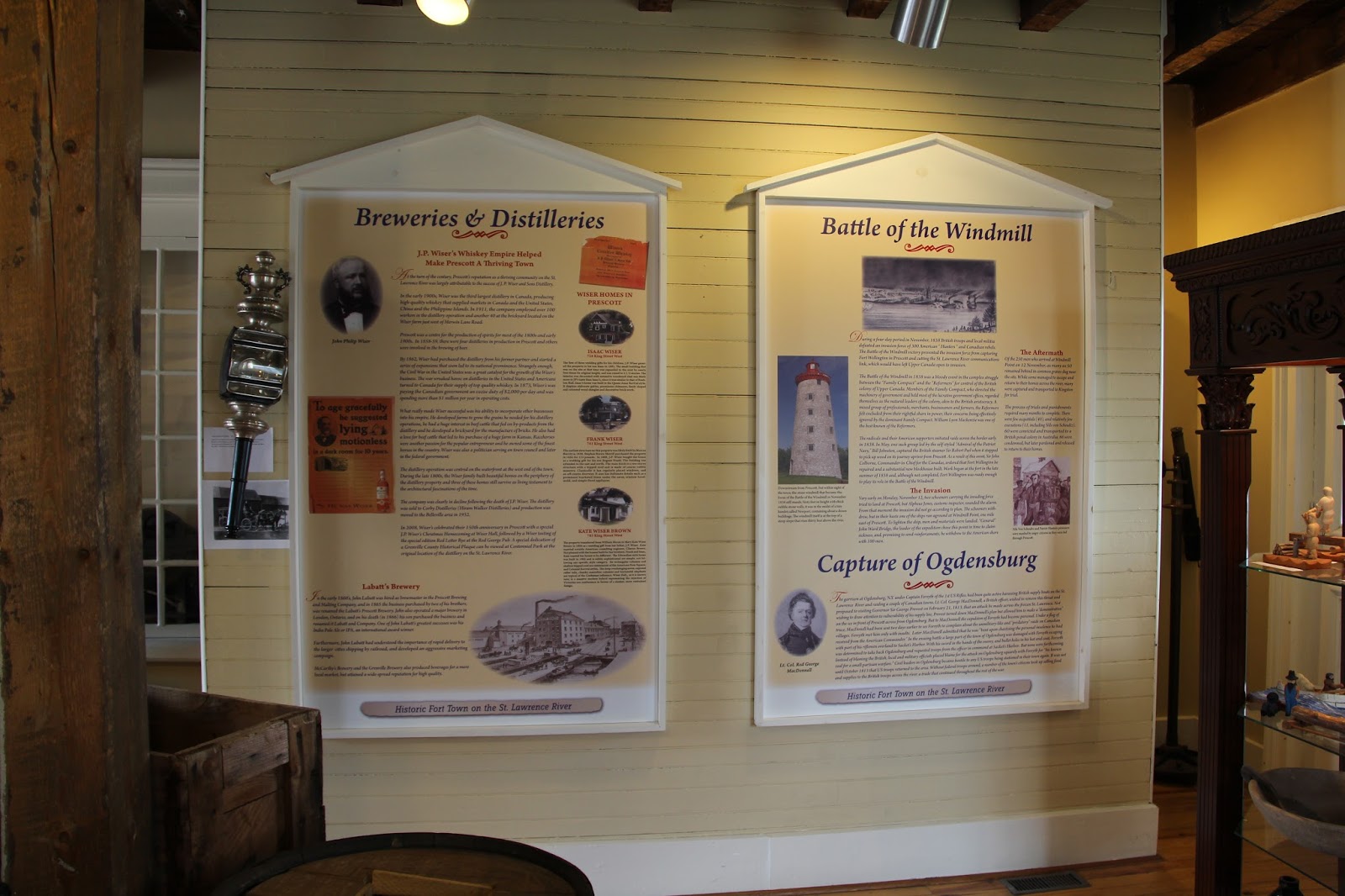
Inside the Forwarders' Museum Visitor Information Centre the visitor will find fascinating historical artifacts and a wealth of information about Prescott's historical sites and the city's history. There is not admission fee and the reception to visitors is friendly.

Au centre d'information du musée des transitaires, les visiteurs découvriront des objets historiques fascinants et une mine d'informations sur les sites historiques de Prescott et l'histoire de la ville. L'entrée est gratuite et l'accueil est chaleureux.